


Page 12 - Read Online
P. 12
Page 10 of 35                          Huang et al. Soft Sci 2024;4:40  https://dx.doi.org/10.20517/ss.2024.37


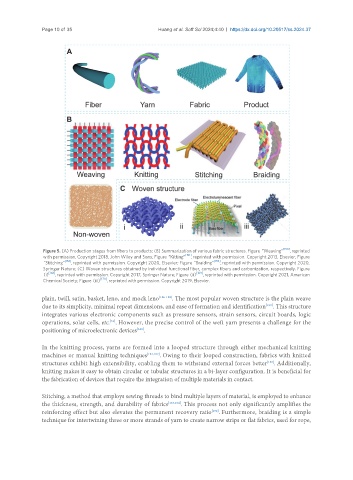
                Figure 5. (A) Production stages from fibers to products; (B) Summarization of various fabric structures. Figure “Weaving” [150] , reprinted
                with permission. Copyright 2018, John Wiley and Sons; Figure “Kitting” [151] , reprinted with permission. Copyright 2013, Elsevier; Figure
                “Stitching” [152] , reprinted with permission. Copyright 2020, Elsevier; Figure  “Braiding” [153] , reprinted with permission. Copyright 2020,
                Springer Nature; (C) Woven structures obtained by individual functional fiber, complex fibers and carbonization, respectively. Figure
                (i) [168] , reprinted with permission. Copyright 2017, Springer Nature; Figure (ii) [169] , reprinted with permission. Copyright 2021, American
                Chemical Society; Figure (iii) [170] , reprinted with permission. Copyright 2019, Elsevier.

               plain, twill, satin, basket, leno, and mock leno [156-158] . The most popular woven structure is the plain weave
               due to its simplicity, minimal repeat dimensions, and ease of formation and identification . This structure
                                                                                           [159]
               integrates various electronic components such as pressure sensors, strain sensors, circuit boards, logic
               operations, solar cells, etc. . However, the precise control of the weft yarn presents a challenge for the
                                      [51]
                                               [160]
               positioning of microelectronic devices .
               In the knitting process, yarns are formed into a looped structure through either mechanical knitting
               machines or manual knitting techniques [161,162] . Owing to their looped construction, fabrics with knitted
               structures exhibit high extensibility, enabling them to withstand external forces better . Additionally,
                                                                                           [160]
               knitting makes it easy to obtain circular or tubular structures in a bi-layer configuration. It is beneficial for
               the fabrication of devices that require the integration of multiple materials in contact.

               Stitching, a method that employs sewing threads to bind multiple layers of material, is employed to enhance
               the thickness, strength, and durability of fabrics [163,164] . This process not only significantly amplifies the
               reinforcing effect but also elevates the permanent recovery ratio . Furthermore, braiding is a simple
                                                                        [152]
               technique for intertwining three or more strands of yarn to create narrow strips or flat fabrics, used for rope,

