


Page 9 - Read Online
P. 9
Huang et al. Soft Sci 2024;4:40  https://dx.doi.org/10.20517/ss.2024.37          Page 7 of 35


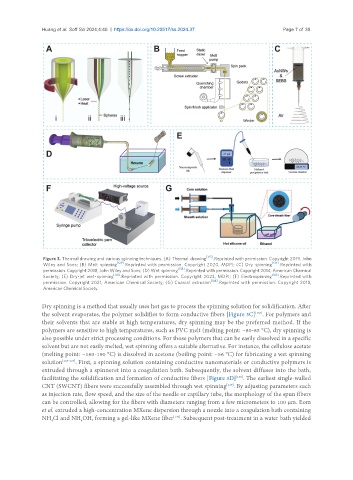
                Figure 3. Thermal drawing and various spinning techniques. (A) Thermal drawing [125] . Reprinted with permission. Copyright 2019, John
                Wiley and Sons; (B) Melt  spinning [129] . Reprinted with permission. Copyright 2020, MDPI; (C) Dry  spinning [134] . Reprinted with
                permission. Copyright 2018, John Wiley and Sons; (D) Wet spinning [138] . Reprinted with permission. Copyright 2014, American Chemical
                Society; (E) Dry-jet wet-spinning [141] . Reprinted with permission. Copyright 2023, MDPI; (F)  Electrospinning [143] . Reprinted with
                permission. Copyright 2021, American Chemical Society; (G) Coaxial  extrusion [144] . Reprinted with permission. Copyright 2018,
                American Chemical Society.


               Dry spinning is a method that usually uses hot gas to process the spinning solution for solidification. After
               the solvent evaporates, the polymer solidifies to form conductive fibers [Figure 3C] . For polymers and
                                                                                       [134]
               their solvents that are stable at high temperatures, dry spinning may be the preferred method. If the
               polymers are sensitive to high temperatures, such as PVC melt (melting point: ~80-85 °C), dry spinning is
               also possible under strict processing conditions. For those polymers that can be easily dissolved in a specific
               solvent but are not easily melted, wet spinning offers a suitable alternative. For instance, the cellulose acetate
               (melting point: ~160-190 °C) is dissolved in acetone (boiling point: ~56 °C) for fabricating a wet spinning
               solution [135-137] . First, a spinning solution containing conductive nanomaterials or conductive polymers is
               extruded through a spinneret into a coagulation bath. Subsequently, the solvent diffuses into the bath,
               facilitating the solidification and formation of conductive fibers [Figure 3D] . The earliest single-walled
                                                                                 [138]
               CNT (SWCNT) fibers were successfully assembled through wet spinning . By adjusting parameters such
                                                                             [139]
               as injection rate, flow speed, and the size of the needle or capillary tube, the morphology of the spun fibers
               can be controlled, allowing for the fibers with diameters ranging from a few micrometers to 100 μm. Eom
               et al. extruded a high-concentration MXene dispersion through a nozzle into a coagulation bath containing
               NH Cl and NH OH, forming a gel-like MXene fiber . Subsequent post-treatment in a water bath yielded
                                                           [140]
                  4
                            4

