


Page 6 - Read Online
P. 6
Page 4 of 35                           Huang et al. Soft Sci 2024;4:40  https://dx.doi.org/10.20517/ss.2024.37


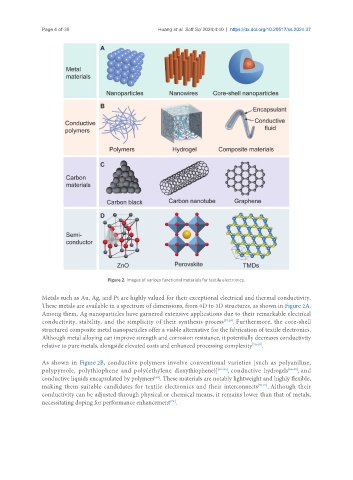
                                     Figure 2. Images of various functional materials for textile electronics.


               Metals such as Au, Ag, and Pt are highly valued for their exceptional electrical and thermal conductivity.
               These metals are available in a spectrum of dimensions, from 0D to 3D structures, as shown in Figure 2A.
               Among them, Ag nanoparticles have garnered extensive applications due to their remarkable electrical
               conductivity, stability, and the simplicity of their synthesis process [57,58] . Furthermore, the core-shell
               structured composite metal nanoparticles offer a viable alternative for the fabrication of textile electronics.
               Although metal alloying can improve strength and corrosion resistance, it potentially decreases conductivity
               relative to pure metals, alongside elevated costs and enhanced processing complexity [59,60] .


               As shown in Figure 2B, conductive polymers involve conventional varieties [such as polyaniline,
               polypyrrole,  polythiophene  and  poly(ethylene  dioxythiophene)] [61-65] , conductive  hydrogels [66-68] , and
                                                     [69]
               conductive liquids encapsulated by polymers . These materials are notably lightweight and highly flexible,
               making them suitable candidates for textile electronics and their interconnects [70,71] . Although their
               conductivity can be adjusted through physical or chemical means, it remains lower than that of metals,
                                                          [72]
               necessitating doping for performance enhancement .

