


Page 5 - Read Online
P. 5
Huang et al. Soft Sci 2024;4:40  https://dx.doi.org/10.20517/ss.2024.37          Page 3 of 35


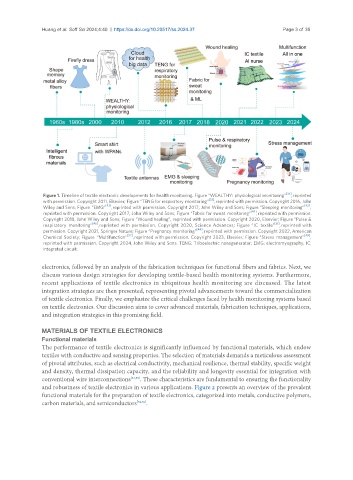
                Figure 1. Timeline of textile electronic developments for health monitoring. Figure “WEALTHY: physiological monitoring” [35] , reprinted
                with permission. Copyright 2011, Elsevier; Figure “TENG for respiratory monitoring” [53] , reprinted with permission. Copyright 2016, John
                Wiley and Sons; Figure  “EMG” [43] , reprinted with permission. Copyright 2017, John Wiley and Sons; Figure “Sleeping  monitoring” [42] ,
                reprinted with permission. Copyright 2017, John Wiley and Sons; Figure “Fabric for sweat  monitoring” [47] , reprinted with permission.
                Copyright 2018, John Wiley and Sons; Figure “Wound healing”, reprinted with permission. Copyright 2020, Elsevier; Figure “Pulse &
                respiratory  monitoring” [45] , reprinted with permission. Copyright 2020, Science Advances; Figure “IC  textile” [51] , reprinted with
                permission. Copyright 2021, Springer Nature; Figure “Pregnancy monitoring” [44] , reprinted with permission. Copyright 2022, American
                Chemical Society; Figure  “Multifunction” [52] , reprinted with permission. Copyright 2023, Elsevier; Figure “Stress  management” [49] ,
                reprinted with permission. Copyright 2024, John Wiley and Sons. TENG: Triboelectric nanogenerator; EMG: electromyography; IC:
                integrated circuit.

               electronics, followed by an analysis of the fabrication techniques for functional fibers and fabrics. Next, we
               discuss various design strategies for developing textile-based health monitoring systems. Furthermore,
               recent applications of textile electronics in ubiquitous health monitoring are discussed. The latest
               integration strategies are then presented, representing pivotal advancements toward the commercialization
               of textile electronics. Finally, we emphasize the critical challenges faced by health monitoring systems based
               on textile electronics. Our discussion aims to cover advanced materials, fabrication techniques, applications,
               and integration strategies in this promising field.


               MATERIALS OF TEXTILE ELECTRONICS
               Functional materials
               The performance of textile electronics is significantly influenced by functional materials, which endow
               textiles with conductive and sensing properties. The selection of materials demands a meticulous assessment
               of pivotal attributes, such as electrical conductivity, mechanical resilience, thermal stability, specific weight
               and density, thermal dissipation capacity, and the reliability and longevity essential for integration with
               conventional wire interconnections [54,55] . These characteristics are fundamental to ensuring the functionality
               and robustness of textile electronics in various applications. Figure 2 presents an overview of the prevalent
               functional materials for the preparation of textile electronics, categorized into metals, conductive polymers,
               carbon materials, and semiconductors [54,56] .

