


Page 136 - Read Online
P. 136
Page 26 of 57                                                       Zheng et al. Soft Sci. 2026, 6, 32


               Electrical properties
               The electrical conductivity of MXene fibers was predominantly determined using the four-probe method at
               room temperature (about 25 °C) and ambient humidity. The electrolyte type, concentration, and scan rate
               used for electrochemical measurements (capacitance, rate performance) are clearly described in the cited
               literature and summarized in the discussion sections. Unless otherwise noted, all capacitance values
               correspond to measurements made in aqueous electrolytes at room temperature (e.g., 1 M and 3 M
               H SO ) [9,123-126] .
                   4
                2
               The key benefits of MXene, a new class of two-dimensional transition metal carbon/nitride compounds,
               come from its remarkable intrinsic conductivity and highly adjustable structural and surface chemical
               characteristics. With film conductivities of up to 6,000-8,000 S·cm , the typical material Ti C T  displays
                                                                         -1
                                                                                              3
                                                                                                2 x
               metalloid-like conductivity. Its high carrier mobility and metal-bond-dominated electrical structure are the
               causes of this characteristic. Many structural elements, such as surface functional group types, interlayer
               stacking states, lattice defect densities, and environmental stability, affect MXene’s conductivity. For
               example, conductivity can be increased by optimizing the electron distribution close to the Fermi level by
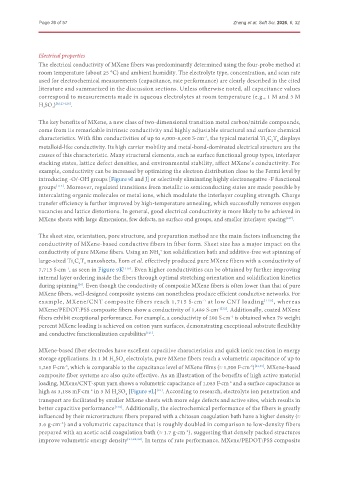
               introducing -O/-OH groups [Figure 9I and J] or selectively eliminating highly electronegative -F functional
               groups [115] . Moreover, regulated transitions from metallic to semiconducting states are made possible by
               intercalating organic molecules or metal ions, which modulate the interlayer coupling strength. Charge
               transfer efficiency is further improved by high-temperature annealing, which successfully removes oxygen
               vacancies and lattice distortions. In general, good electrical conductivity is more likely to be achieved in
               MXene sheets with large dimensions, few defects, no surface end groups, and smaller interlayer spacing .
                                                                                                     [127]

               The sheet size, orientation, pore structure, and preparation method are the main factors influencing the
               conductivity of MXene-based conductive fibers in fiber form. Sheet size has a major impact on the
               conductivity of pure MXene fibers. Using an NH  ion solidification bath and additive-free wet spinning of
                                                         +
                                                         4
               large-sized Ti C T  nanosheets, Eom et al. effectively produced pure MXene fibers with a conductivity of
                           3
                             2 x
               7,713 S·cm , as seen in Figure 9K [116] . Even higher conductivities can be obtained by further improving
                        -1
               internal layer ordering inside the fibers through optimal stretching orientation and solidification kinetics
               during spinning . Even though the conductivity of composite MXene fibers is often lower than that of pure
                            [26]
               MXene fibers, well-designed composite systems can nonetheless produce efficient conductive networks. For
               example, MXene/CNT composite fibers reach 1,715 S·cm  at low CNT loading       [120] , whereas
                                                                        -1
               MXene/PEDOT:PSS composite fibers show a conductivity of 1,489 S·cm -1[32] . Additionally, coated MXene
               fibers exhibit exceptional performance. For example, a conductivity of 200 S·cm  is obtained when 79 weight
                                                                                  -1
               percent MXene loading is achieved on cotton yarn surfaces, demonstrating exceptional substrate flexibility
               and conductive functionalization capabilities .
                                                    [121]

               MXene-based fiber electrodes have excellent capacitive characteristics and quick ionic reaction in energy
               storage applications. In 1 M H SO  electrolyte, pure MXene fibers reach a volumetric capacitance of up to
                                            4
                                         2
               1,265 F·cm , which is comparable to the capacitance level of MXene films (≈ 1,500 F·cm )  . MXene-based
                        -3
                                                                                         -3 [21,33]
               composite fiber systems are also quite effective. As an illustration of the benefits of high active material
               loading, MXene/CNT-spun yarn shows a volumetric capacitance of 1,083 F·cm  and a surface capacitance as
                                                                                 -3
               high as 3,188 mF·cm  in 3 M H SO  [Figure 9L] . According to research, electrolyte ion penetration and
                                                        [31]
                                 -2
                                             4
                                          2
               transport are facilitated by smaller MXene sheets with more edge defects and active sites, which results in
               better capacitive performance [128] . Additionally, the electrochemical performance of the fibers is greatly
               influenced by their microstructure: fibers prepared with a chitosan coagulation bath have a higher density (≈
               3.6 g·cm ) and a volumetric capacitance that is roughly doubled in comparison to low-density fibers
                      -3
               prepared with an acetic acid coagulation bath (≈ 1.7 g·cm ), suggesting that densely packed structures
                                                                  -3
               improve volumetric energy density [21,23,24] . In terms of rate performance, MXene/PEDOT:PSS composite

