


Page 132 - Read Online
P. 132
Page 22 of 57                                                       Zheng et al. Soft Sci. 2026, 6, 32


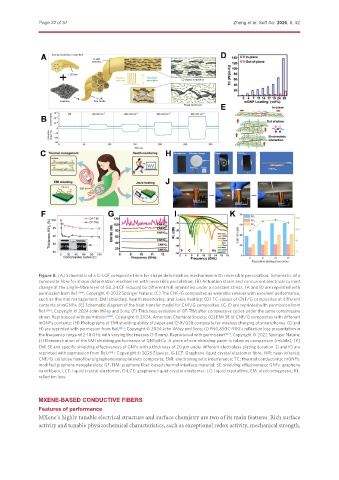
               Figure 8. (A) Schematic of a G-LCF composite fibre for shape deformation mechanism with reversible percolation. Schematic of a
               composite fibre for shape deformation mechanism with reversible percolation; (B) Actuation strain and concurrent electrical current
               change at the single-fibre level of G0.3-LCF induced by different NIR intensities under a constant stress. (A and B) are reprinted with
               permission from Ref. [104] , Copyright © 2022 Springer Nature; (C) The CNF/G composites as wearable sensors with excellent performance,
               such as thermal management, EMI shielding, health monitoring, and Joule heating; (D) TC values of CNF/G composites at different
               contents of mGNPs; (E) Schematic diagram of the heat transfer model for CNF/G composites. (C-E) are reprinted with permission from
               Ref. [105] , Copyright © 2024 John Wiley and Sons; (F) Thickness evolution of GF-TIM after compressive cycles under the same compressive
               strain. Reproduced with permission [106] , Copyright © 2024, American Chemical Society; (G) EMI SE of CNF/G composites with different
               mGNPs contents; (H) Photographs of EMI shielding ability of paper and CNF/G28 composite for wireless charging of smartphones. (G and
               H) are reprinted with permission from Ref. [105] , Copyright © 2024 John Wiley and Sons; (I) PN0.85GC-900’s reflection loss presentation in
               the frequency range of 2-18 GHz with varying thicknesses (1-5 mm). Reproduced with permission [107] , Copyright © 2022 Springer Nature;
               (J) Demonstration of the EMI shielding performance of GNF@tCu. A piece of non-shielding paper is taken as comparison (middle); (K)
               EMI SE and specific shielding effectiveness of GNFs with a thickness of 20 μm under different electroless plating duration. (J and K) are
               reprinted with permission from Ref. [108] , Copyright © 2025 Elsevier. G-LCF: Graphene liquid crystal elastomer fibre; NIR: near-infrared;
               CNF/G: cellulose nanofibers/graphene nanoplatelets composite; EMI: electromagnetic interference; TC: thermal conductivity; mGNPs:
               modified graphene nanoplatelets; GF-TIM: graphene fiber-based thermal interface material; SE: shielding effectiveness; GNFs: graphene
               nanofibers; LCE: liquid crystal elastomer; G-LCE: graphene liquid crystal elastomer; LC: liquid crystalline; EM: electromagnetic; RL:
               reflection loss.


               MXENE-BASED CONDUCTIVE FIBERS
               Features of performance
               MXene’s highly tunable electrical structure and surface chemistry are two of its main features. Rich surface
               activity and tunable physicochemical characteristics, such as exceptional redox activity, mechanical strength,

