


Page 128 - Read Online
P. 128
Page 18 of 57                                                       Zheng et al. Soft Sci. 2026, 6, 32


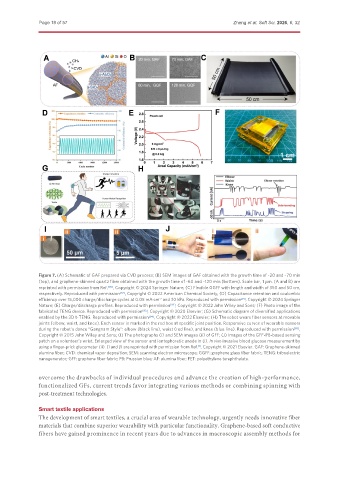
               Figure 7. (A) Schematic of GAF prepared via CVD process; (B) SEM images of GAF obtained with the growth time of ~20 and ~70 min
               (top), and graphene-skinned quartz fiber obtained with the growth time of ~60 and ~120 min (bottom). Scale bar, 1 μm. (A and B) are
               reprinted with permission from Ref. [90] , Copyright © 2024 Springer Nature; (C) Flexible GGFF with length and width of 350 and 50 cm,
               respectively. Reproduced with permission [57] , Copyright © 2022 American Chemical Society; (D) Capacitance retention and coulombic
               efficiency over 15,000 charge/discharge cycles at 0.05 mA·cm  and 30 kPa. Reproduced with permission , Copyright © 2024 Springer
                                                         -2
                                                                                      [91]
               Nature; (E) Charge/discharge profiles. Reproduced with permission [92] , Copyright © 2022 John Wiley and Sons; (F) Photo image of the
               fabricated TENG device. Reproduced with permission [93] , Copyright © 2020 Elsevier; (G) Schematic diagram of diversified applications
               enabled by the 3D t-TENG. Reproduced with permission [94] , Copyright © 2022 Elsevier; (H) The robot wears fiber sensors at movable
               joints (elbow, waist, and knee). Each sensor is marked in the red box at specific joint position. Responsive curves of wearable sensors
               during the robot’s dance “Gangnam Style”: elbow (black line), waist (red line), and knee (blue line). Reproduced with permission [95] ,
               Copyright © 2015 John Wiley and Sons; (I) The photographs (i) and SEM images (ii) of GFF; (J) Images of the GFF-PB-based sensing
               patch on a volunteer’s wrist. Enlarged view of the sensor and iontophoretic anode in (i). In vivo invasive blood glucose measurement by
               using a finger-prick glucometer (ii). (I and J) are reprinted with permission from Ref. , Copyright © 2021 Elsevier. GAF: Graphene-skinned
                                                                      [1]
               alumina fiber; CVD: chemical vapor deposition; SEM: scanning electron microscope; GGFF: graphene glass fiber fabric; TENG: triboelectric
               nanogenerator; GFF: graphene fiber fabric; PB: Prussian blue; AF: alumina fiber; PET: polyethylene terephthalate.


               overcome the drawbacks of individual procedures and advance the creation of high-performance,
               functionalized GFs, current trends favor integrating various methods or combining spinning with
               post-treatment technologies.


               Smart textile applications
               The development of smart textiles, a crucial area of wearable technology, urgently needs innovative fiber
               materials that combine superior wearability with particular functionality. Graphene-based soft conductive
               fibers have gained prominence in recent years due to advances in macroscopic assembly methods for

