


Page 133 - Read Online
P. 133
Zheng et al. Soft Sci. 2026, 6, 32 Page 23 of 57
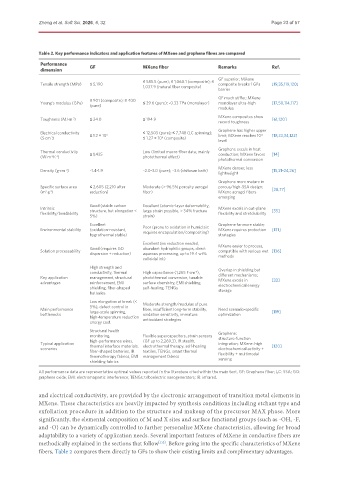
Table 2. Key performance indicators and application features of MXene and graphene fibres are compared
Performance GF MXene fiber Remarks Ref.
dimension
GF superior; MXene
≤ 585.5 (pure); ≤ 1,060.1 (composite); ≤
Tensile strength (MPa) ≤ 5,190 composite breaks 1 GPa [19,35,119,120]
1,037.9 (natural fiber composite)
barrier
GF much stiffer; MXene
≤ 901 (composite); ≤ 400
Young’s modulus (GPa) ≤ 29.6 (pure); ~0.33 TPa (monolayer) monolayer ultra-high [17,50,114,117]
(pure)
modulus
MXene composites show
Toughness (MJ·m ) ≤ 24.0 ≤ 194.9 [61,120]
-3
record toughness
Graphene has higher upper
Electrical conductivity ≤ 1.2 × 10 6 ≤ 12,503 (pure); ≤ 7,748 (LC spinning); limit; MXene reaches 10 4 [18,33,34,122]
4
-1
(S·cm ) ≤ 1.27 × 10 (composite)
level
Graphene excels in heat
Thermal conductivity ≤ 1,435 Low (limited macro-fiber data; mainly conduction; MXene favors [14]
-1
-1
(W·m ·K ) photothermal effect)
photothermal conversion
MXene denser, less
-3
Density (g·cm ) ~1.4-1.9 ~2.0-3.0 (pure); ~3.6 (chitosan bath) [15,21-24,26]
lightweight
Graphene more mature in
Specific surface area ≤ 2,605 (2,210 after Moderate (> 96.5% porosity aerogel porous/high-SSA design;
(m ·g ) reduction) fiber) MXene aerogel fibers [28,77]
2
-1
emerging
Good (stable carbon Excellent (atomic-layer deformability,
Intrinsic structure, but elongation < large strain possible, > 34% fracture MXene excels in out-plane [35]
flexibility/bendability flexibility and stretchability
5%) strain)
Excellent Graphene far more stable;
Environmental stability (oxidation-resistant, Poor (prone to oxidation in humid air; MXene requires protection [131]
hygrothermal stable) requires encapsulation/compositing) strategies
Excellent (no reduction needed,
Good (requires GO abundant hydrophilic groups, direct MXene easier to process,
Solution processability compatible with various wet [136]
dispersion + reduction) aqueous processing, up to 19.4 wt%
colloidal ink) methods
High strength and
conductivity, thermal High capacitance (1,265 F·cm ), Overlap in shielding but
-3
Key application management, structural photothermal conversion, tunable different mechanisms;
advantages reinforcement, EMI surface chemistry, EMI shielding, MXene excels in [33]
shielding, fiber-shaped self-healing, TENGs electrochemical energy
batteries storage
Low elongation at break (<
5%), defect control in Moderate strength/modulus of pure
Main performance large-scale spinning, fiber, insufficient long-term stability, Need scenario-specific [119]
bottlenecks oxidation sensitivity, immature optimization
high-temperature reduction
energy cost antioxidant strategies
Structural health
monitoring, Flexible supercapacitors, strain sensors Graphene:
high-performance wires, (GF up to 2,269.3), IR stealth, structure-function
Typical application thermal interface materials, electrothermal therapy, self-healing integration; MXene: high [120]
scenarios electrochemical activity +
fiber-shaped batteries, IR textiles, TENGs, smart thermal
thermotherapy fabrics, EMI management fabrics flexibility + multimodal
shielding fabrics sensing
All performance data are representative optimal values reported in the literature cited within the main text. GF: Graphene fiber; LC: SSA: GO:
graphene oxide; EMI: electromagnetic interference; TENGs: triboelectric nanogenerators; IR: infrared.
and electrical conductivity, are provided by the electronic arrangement of transition metal elements in
MXene. These characteristics are heavily impacted by synthesis conditions including etchant type and
exfoliation procedure in addition to the structure and makeup of the precursor MAX phase. More
significantly, the elemental composition of M and X sites and surface functional groups (such as -OH, -F,
and -O) can be dynamically controlled to further personalize MXene characteristics, allowing for broad
adaptability to a variety of application needs. Several important features of MXene in conductive fibers are
methodically explained in the sections that follow . Before going into the specific characteristics of MXene
[112]
fibers, Table 2 compares them directly to GFs to show their existing limits and complimentary advantages.

