


Page 138 - Read Online
P. 138
Page 28 of 57                                                       Zheng et al. Soft Sci. 2026, 6, 32


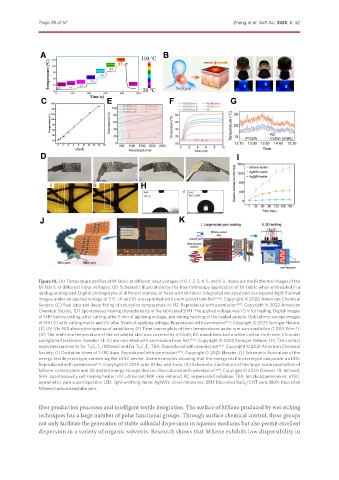
               Figure 10. (A) Temperature profiles of M-fabric at different input voltages of 0, 1, 2, 3, 4, 5, and 6 V. Insets are the IR thermal images of the
               M-fabric at different input voltages; (B) Schematic illustration for the thermotherapy application of M-fabric when embedded in a
               neck-guarding pad. Digital photographs of different stances of head with M-fabric integrated neckpad and correspondingIR thermal
               images under an applied voltage of 3 V. (A and B) are reprinted with permission from Ref. [130] , Copyright © 2020 American Chemical
               Society; (C) Real data and linear fitting of saturation temperature vs. U2. Reproduced with permission [131] , Copyright © 2022 American
               Chemical Society; (D) Spontaneous healing characteristics of the fabricated SHH. The applied voltage was 1.5 V for healing. Digital images
               of SHH before cutting, after cutting, after 5 min of applying voltage, and during twisting of the healed sample. Optical microscope images
               of SHH (i) with cutting marks and (ii) after 5 min of applying voltage. Reproduced with permission [132] , Copyright © 2023 Springer Nature;
               (E) UV-Vis-NIR absorption spectra of nanofibers; (F) Time course plots of their temperatures under one-sun irradiation (1,000 W·m );
                                                                                                         -2
               (G) The real-time temperature of the simulated skin was covered by if-Cloth, RC nanofibers and a white cotton cloth over 3 h under
               sunlight in Stockholm, Sweden. (E-G) are reprinted with permission from Ref. [133] , Copyright © 2023 Springer Nature; (H) The contact
               angle measurements for Ti 3 C 2 T x  (MXene) and for Ti 3 C 2 T x -TBA. Reproduced with permission [134] , Copyright © 2021 American Chemical
               Society; (I) Oxidation times of 1-180 days. Reproduced with permission [135] , Copyright © 2025 Elsevier; (J) Schematic illustration of the
               energy textile prototype containing the aYSC device. Some examples showing that the energy textile prototype can power an LED.
               Reproduced with permission [31] , Copyright © 2018 John Wiley and Sons; (K) Schematic illustration of the large-scale production of
               MXene-coated yarns and 3D knitted energy storage devices. Reproduced with permission [136] , Copyright © 2020 Elsevier. IR: Infrared;
               SHH: spontaneously self-healing heater; UV: ultraviolet; NIR: near-infrared; RC: regenerated cellulose; TBA: tetrabutylammonium; aYSC:
               asymmetric yarn supercapacitor; LED: light-emitting diode; AgNWs: silver nanowires; BRU: biscrolled RuO 2 /CNT yarn; BMX: biscrolled
               MXene/carbon nanotube yarn.


               fiber production processes and intelligent textile integration. The surface of MXene produced by wet etching
               techniques has a large number of polar functional groups. Through surface chemical control, these groups
               not only facilitate the generation of stable colloidal dispersions in aqueous mediums but also permit excellent
               dispersion in a variety of organic solvents. Research shows that MXene exhibits low dispersibility in

