


Page 71 - Read Online
P. 71
Page 10 of 15                          Zhong et al. Soft Sci. 2025, 5, 3  https://dx.doi.org/10.20517/ss.2024.52


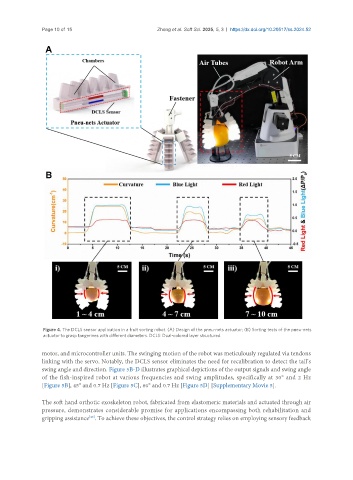
                Figure 4. The DCLS sensor application in a fruit sorting robot. (A) Design of the pneu-nets actuator; (B) Sorting tests of the pneu-nets
                actuator to grasp tangerines with different diameters. DCLS: Dual-colored layer structured.


               motor, and microcontroller units. The swinging motion of the robot was meticulously regulated via tendons
               linking with the servo. Notably, the DCLS sensor eliminates the need for recalibration to detect the tail’s
               swing angle and direction. Figure 5B-D illustrates graphical depictions of the output signals and swing angle
               of the fish-inspired robot at various frequencies and swing amplitudes, specifically at 30° and 2 Hz
               [Figure 5B], 45° and 0.7 Hz [Figure 5C], 60° and 0.7 Hz [Figure 5D] [Supplementary Movie 5].


               The soft hand orthotic exoskeleton robot, fabricated from elastomeric materials and actuated through air
               pressure, demonstrates considerable promise for applications encompassing both rehabilitation and
               gripping assistance . To achieve these objectives, the control strategy relies on employing sensory feedback
                               [45]

