


Page 67 - Read Online
P. 67
Page 6 of 15                           Zhong et al. Soft Sci. 2025, 5, 3  https://dx.doi.org/10.20517/ss.2024.52

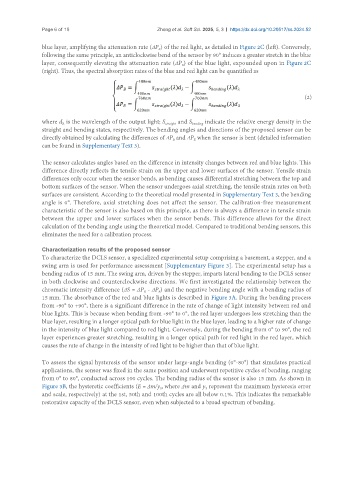
               blue layer, amplifying the attenuation rate (ΔP ) of the red light, as detailed in Figure 2C (left). Conversely,
                                                      R
               following the same principle, an anticlockwise bend of the sensor by 90° induces a greater stretch in the blue
               layer, consequently elevating the attenuation rate (ΔP ) of the blue light, expounded upon in Figure 2C
                                                              B
               (right). Thus, the spectral absorption rates of the blue and red light can be quantified as


                                                                                                        (2)


               where d  is the wavelength of the output light; S straight  and S bending  indicate the relative energy density in the
                      λ
               straight and bending states, respectively. The bending angles and directions of the proposed sensor can be
               directly obtained by calculating the differences of ΔP  and ΔP  when the sensor is bent (detailed information
                                                           B
                                                                  R
               can be found in Supplementary Text 3).
               The sensor calculates angles based on the difference in intensity changes between red and blue lights. This
               difference directly reflects the tensile strain on the upper and lower surfaces of the sensor. Tensile strain
               differences only occur when the sensor bends, as bending causes differential stretching between the top and
               bottom surfaces of the sensor. When the sensor undergoes axial stretching, the tensile strain rates on both
               surfaces are consistent. According to the theoretical model presented in Supplementary Text 3, the bending
               angle is 0°. Therefore, axial stretching does not affect the sensor. The calibration-free measurement
               characteristic of the sensor is also based on this principle, as there is always a difference in tensile strain
               between the upper and lower surfaces when the sensor bends. This difference allows for the direct
               calculation of the bending angle using the theoretical model. Compared to traditional bending sensors, this
               eliminates the need for a calibration process.


               Characterization results of the proposed sensor
               To characterize the DCLS sensor, a specialized experimental setup comprising a basement, a stepper, and a
               swing arm is used for performance assessment [Supplementary Figure 3]. The experimental setup has a
               bending radius of 15 mm. The swing arm, driven by the stepper, imparts lateral bending to the DCLS sensor
               in both clockwise and counterclockwise directions. We first investigated the relationship between the
               chromatic intensity difference (ΔS = ΔP  - ΔP ) and the negative bending angle with a bending radius of
                                                 R
                                                      B
               15 mm. The absorbance of the red and blue lights is described in Figure 3A. During the bending process
               from -90° to +90°, there is a significant difference in the rate of change of light intensity between red and
               blue lights. This is because when bending from -90° to 0°, the red layer undergoes less stretching than the
               blue layer, resulting in a longer optical path for blue light in the blue layer, leading to a higher rate of change
               in the intensity of blue light compared to red light. Conversely, during the bending from 0° to 90°, the red
               layer experiences greater stretching, resulting in a longer optical path for red light in the red layer, which
               causes the rate of change in the intensity of red light to be higher than that of blue light.

               To assess the signal hysteresis of the sensor under large-angle bending (0°-80°) that simulates practical
               applications, the sensor was fixed in the same position and underwent repetitive cycles of bending, ranging
               from 0° to 80°, conducted across 100 cycles. The bending radius of the sensor is also 15 mm. As shown in
               Figure 3B, the hysteretic coefficients (E = Δm/y , where Δm and y  represent the maximum hysteresis error
                                                                      S
                                                       S
               and scale, respectively) at the 1st, 50th and 100th cycles are all below 0.1%. This indicates the remarkable
               restorative capacity of the DCLS sensor, even when subjected to a broad spectrum of bending.

