


Page 68 - Read Online
P. 68
Zhong et al. Soft Sci. 2025, 5, 3  https://dx.doi.org/10.20517/ss.2024.52        Page 7 of 15


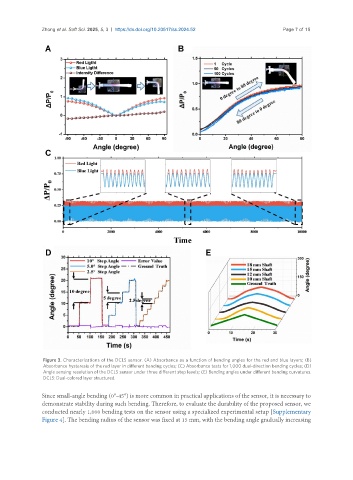
                Figure 3. Characterizations of the DCLS sensor. (A) Absorbance as a function of bending angles for the red and blue layers; (B)
                Absorbance hysteresis of the red layer in different bending cycles; (C) Absorbance tests for 1,000 dual-direction bending cycles; (D)
                Angle sensing resolution of the DCLS sensor under three different step levels; (E) Bending angles under different bending curvatures.
                DCLS: Dual-colored layer structured.

               Since small-angle bending (0°-45°) is more common in practical applications of the sensor, it is necessary to
               demonstrate stability during such bending. Therefore, to evaluate the durability of the proposed sensor, we
               conducted nearly 1,000 bending tests on the sensor using a specialized experimental setup [Supplementary
               Figure 4]. The bending radius of the sensor was fixed at 15 mm, with the bending angle gradually increasing

