


Page 64 - Read Online
P. 64
Zhong et al. Soft Sci. 2025, 5, 3  https://dx.doi.org/10.20517/ss.2024.52        Page 3 of 15


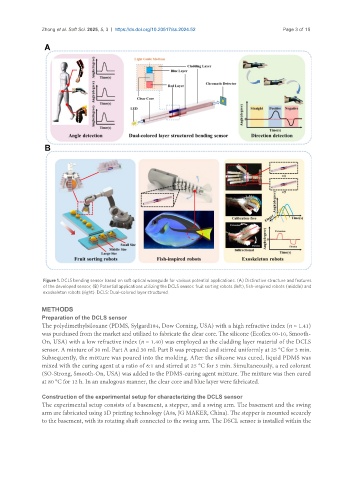
                Figure 1. DCLS bending sensor based on soft optical waveguide for various potential applications. (A) Distinctive structure and features
                of the developed sensor; (B) Potential applications utilizing the DCLS sensor: fruit sorting robots (left), fish-inspired robots (middle) and
                exoskeleton robots (right). DCLS: Dual-colored layer structured.


               METHODS
               Preparation of the DCLS sensor
               The polydimethylsiloxane (PDMS, Sylgard184, Dow Corning, USA) with a high refractive index (n ≈ 1.41)
               was purchased from the market and utilized to fabricate the clear core. The silicone (Ecoflex 00-10, Smooth-
               On, USA) with a low refractive index (n ≈ 1.40) was employed as the cladding layer material of the DCLS
               sensor. A mixture of 30 mL Part A and 30 mL Part B was prepared and stirred uniformly at 25 °C for 3 min.
               Subsequently, the mixture was poured into the molding. After the silicone was cured, liquid PDMS was
               mixed with the curing agent at a ratio of 6:1 and stirred at 25 °C for 5 min. Simultaneously, a red colorant
               (SO-Strong, Smooth-On, USA) was added to the PDMS-curing agent mixture. The mixture was then cured
               at 80 °C for 12 h. In an analogous manner, the clear core and blue layer were fabricated.

               Construction of the experimental setup for characterizing the DCLS sensor
               The experimental setup consists of a basement, a stepper, and a swing arm. The basement and the swing
               arm are fabricated using 3D printing technology (A8s, JG MAKER, China). The stepper is mounted securely
               to the basement, with its rotating shaft connected to the swing arm. The DSCL sensor is installed within the

