


Page 43 - Read Online
P. 43
Wang et al. Soft Sci 2024;4:41  https://dx.doi.org/10.20517/ss.2024.53          Page 25 of 43


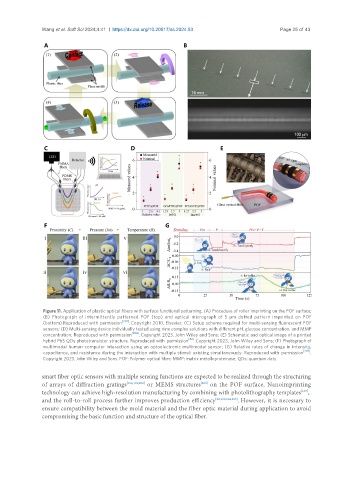
                Figure 11. Application of plastic optical fibers with surface functional patterning. (A) Procedure of roller imprinting on the POF surface;
                (B)  Photograph  of  intermittently  patterned  POF  (top)  and  optical  micrograph  of  5  μm  dotted  pattern  imprinted  on  POF
                (bottom).Reproduced with  permission [202] . Copyright 2010, Elsevier; (C) Setup scheme required for multi-sensing fluorescent POF
                sensors; (D) Multi-sensing device individually tested using nine complex solutions with different pH, glucose concentration, and MMP
                concentration. Reproduced with  permission [206] . Copyright 2023, John Wiley and Sons; (E) Schematic and optical image of a printed
                hybrid PbS QDs phototransistor structure. Reproduced with  permission [42] . Copyright 2023, John Wiley and Sons; (F) Photograph of
                multimodal human-computer interaction using an optoelectronic multimodal sensor; (G) Relative rates of change in intensity,
                capacitance, and resistance during the interaction with multiple stimuli existing simultaneously. Reproduced with  permission [201] .
                Copyright 2023, John Wiley and Sons. POF: Polymer optical fiber; MMP: matrix metalloproteinase; QDs: quantum dots.

               smart fiber optic sensors with multiple sensing functions are expected to be realized through the structuring
                                                                     [200]
               of arrays of diffraction gratings [106,199,203]  or MEMS structures  on the POF surface. Nanoimprinting
                                                                                                      [107]
               technology can achieve high-resolution manufacturing by combining with photolithography templates ,
               and the roll-to-roll process further improves production efficiency [22,199,204,205] . However, it is necessary to
               ensure compatibility between the mold material and the fiber optic material during application to avoid
               compromising the basic function and structure of the optical fiber.

