


Page 41 - Read Online
P. 41
Wang et al. Soft Sci 2024;4:41  https://dx.doi.org/10.20517/ss.2024.53          Page 23 of 43


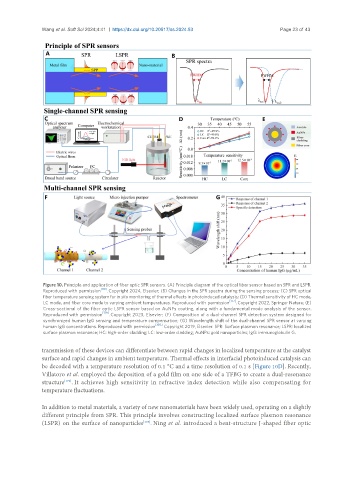
                Figure 10. Principle and application of fiber optic SPR sensors. (A) Principle diagram of the optical fiber sensor based on SPR and LSPR.
                Reproduced with permission [110] . Copyright 2024, Elsevier; (B) Changes in the SPR spectra during the sensing process; (C) SPR optical
                fiber temperature sensing system for in situ monitoring of thermal effects in photoinduced catalysis; (D) Thermal sensitivity of HC mode,
                LC mode, and fiber core mode to varying ambient temperatures. Reproduced with permission [177] . Copyright 2022, Springer Nature; (E)
                Cross-sectional of the fiber optic LSPR sensor based on AuNPs coating, along with a fundamental mode analysis of the sensor.
                Reproduced with  permission [179] . Copyright 2023, Elsevier; (F) Composition of a dual-channel SPR detection system designed for
                synchronized human IgG sensing and temperature compensation; (G) Wavelength shift of the dual-channel SPR sensor at varying
                human IgG concentrations. Reproduced with permission [190] . Copyright 2019, Elsevier. SPR: Surface plasmon resonance; LSPR: localized
                surface plasmon resonance; HC: high-order cladding; LC: low-order cladding; AuNPs: gold nanoparticles; IgG: immunoglobulin G.

               transmission of these devices can differentiate between rapid changes in localized temperature at the catalyst
               surface and rapid changes in ambient temperature. Thermal effects in interfacial photoinduced catalysis can
               be decoded with a temperature resolution of 0.1 °C and a time resolution of 0.1 s [Figure 10D]. Recently,
               Villatoro et al. employed the deposition of a gold film on one side of a TFBG to create a dual-resonance
               structure . It achieves high sensitivity in refractive index detection while also compensating for
                       [172]
               temperature fluctuations.

               In addition to metal materials, a variety of new nanomaterials have been widely used, operating on a slightly
               different principle from SPR. This principle involves constructing localized surface plasmon resonance
                                                 [178]
               (LSPR) on the surface of nanoparticles . Ning et al. introduced a bent-structure J-shaped fiber optic

