


Page 154 - Read Online
P. 154
Wang et al. Soft Sci. 2025, 5, 28  https://dx.doi.org/10.20517/ss.2025.11        Page 5 of 29


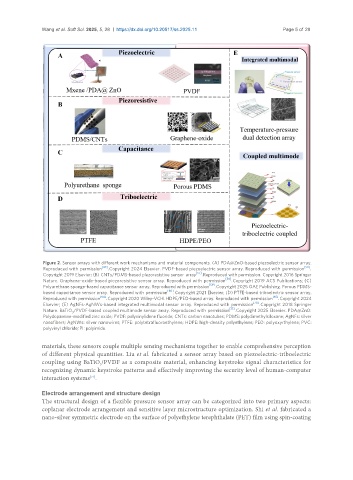
                Figure 2. Sensor arrays with different work mechanisms and material components. (A) PDA@ZnO-based piezoelectric sensor array.
                Reproduced with  permission [49] . Copyright 2024 Elsevier. PVDF-based piezoelectric sensor array. Reproduced with  permission [50] .
                Copyright 2019 Elsevier; (B) CNTs/PDMS-based piezoresistive sensor array [57] . Reproduced with permission. Copyright 2016 Springer
                Nature. Graphene-oxide-based piezoresistive sensor array. Reproduced with  permission [58] . Copyright 2019 ACS Publications; (C)
                Polyurethane sponge-based capacitance sensor array. Reproduced with permission [59] . Copyright 2025 OAE Publishing. Porous PDMS-
                based capacitance sensor array. Reproduced with  permission [60] . Copyright 2021 Elsevier; (D) PTFE-based triboelectric sensor array.
                Reproduced with permission [64] . Copyright 2020 Wiley-VCH. HDPE/PEO-based array. Reproduced with permission [65] . Copyright 2024
                Elsevier; (E) AgNFs-AgNWs-based integrated multimodal sensor array. Reproduced with  permission [70] . Copyright 2018 Springer
                Nature. BaTiO /PVDF-based coupled multimode sensor array. Reproduced with  permission [71] . Copyright 2025 Elsevier. PDA@ZnO:
                         3
                Polydopamine-modified zinc oxide; PVDF: polyvinylidene fluoride; CNTs: carbon nanotubes; PDMS: polydimethylsiloxane; AgNFs: silver
                nanofibers; AgNWs: silver nanowires; PTFE: polytetrafluoroethylene; HDPE: high-density polyethylene; PEO: polyoxyrthylene; PVC:
                polyvinyl chloride; PI: polyimide.

               materials, these sensors couple multiple sensing mechanisms together to enable comprehensive perception
               of different physical quantities. Liu et al. fabricated a sensor array based on piezoelectric-triboelectric
               coupling using BaTiO /PVDF as a composite material, enhancing keystroke signal characteristics for
                                   3
               recognizing dynamic keystroke patterns and effectively improving the security level of human-computer
                               [71]
               interaction systems .
               Electrode arrangement and structure design
               The structural design of a flexible pressure sensor array can be categorized into two primary aspects:
               coplanar electrode arrangement and sensitive layer microstructure optimization. Shi et al. fabricated a
               nano-silver symmetric electrode on the surface of polyethylene terephthalate (PET) film using spin-coating

