


Page 153 - Read Online
P. 153
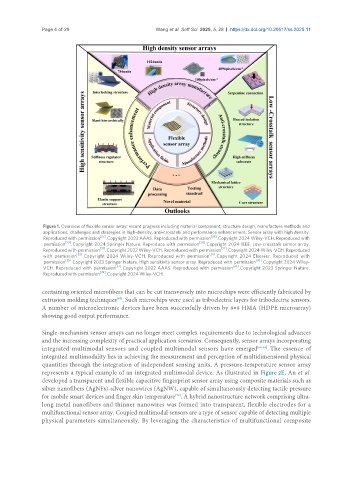
Page 4 of 29                           Wang et al. Soft Sci. 2025, 5, 28  https://dx.doi.org/10.20517/ss.2025.11


                Figure 1. Overview of flexible sensor array: recent progress including material component, structure design, manufacture methods and
                applications; challenges and strategies in high-density, anti-crosstalk and performance enhancement. Sensor array with high density.
                Reproduced with permission [27] . Copyright 2023 AAAS. Reproduced with permission [28] . Copyright 2024 Wiley-VCH. Reproduced with
                permission [29] . Copyright 2024 Springer Nature. Reproduce with  permission [30] . Copyright 2024 IEEE. Low-crosstalk sensor array.
                Reproduced with permission [31] . Copyright 2022 Wiley-VCH. Reproduced with permission [32] . Copyright 2024 Wiley-VCH. Reproduced
                with  permission [33] . Copyright  2024  Wiley-VCH.  Reproduced  with  permission [34] . Copyright  2024  Elsevier.  Reproduced  with
                permission [35] . Copyright 2023 Springer Nature. High sensitivity sensor array. Reproduced with permission [36] . Copyright 2024 Wiley-
                VCH. Reproduced with  permission [37] . Copyright 2022 AAAS. Reproduced with  permission [38] . Copyright 2023 Springer Nature.
                Reproduced with permission [39] . Copyright 2024 Wiley-VCH.


               containing oriented microfibers that can be cut transversely into microchips were efficiently fabricated by
                                        [65]
               extrusion molding techniques . Such microchips were used as triboelectric layers for triboelectric sensors.
               A number of microelectronic devices have been successfully driven by 8×8 HMA (HDPE microarray)
               showing good output performance.

               Single-mechanism sensor arrays can no longer meet complex requirements due to technological advances
               and the increasing complexity of practical application scenarios. Consequently, sensor arrays incorporating
               integrated multimodal sensors and coupled multimodal sensors have emerged [66-69] . The essence of
               integrated multimodality lies in achieving the measurement and perception of multidimensional physical
               quantities through the integration of independent sensing units. A pressure-temperature sensor array
               represents a typical example of an integrated multimodal device. As illustrated in Figure 2E, An et al.
               developed a transparent and flexible capacitive fingerprint sensor array using composite materials such as
               silver nanofibers (AgNFs)-silver nanowires (AgNW), capable of simultaneously detecting tactile pressure
                                                            [70]
               for mobile smart devices and finger skin temperature . A hybrid nanostructure network comprising ultra-
               long metal nanofibers and thinner nanowires was formed into transparent, flexible electrodes for a
               multifunctional sensor array. Coupled multimodal sensors are a type of sensor capable of detecting multiple
               physical parameters simultaneously. By leveraging the characteristics of multifunctional composite

