


Page 41 - Read Online
P. 41
Park et al. Soft Sci 2024;4:28  https://dx.doi.org/10.20517/ss.2024.22          Page 15 of 28


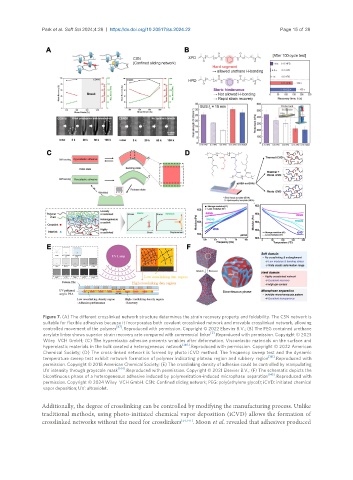
                Figure 7. (A) The different crosslinked network structure determines the strain recovery property and foldability. The CSN network is
                suitable for flexible adhesives because it incorporates both covalent crosslinked network and movable crosslinked network, allowing
                controlled movement of the polymer [87] . Reproduced with permission. Copyright © 2022 Elsevier B.V.; (B) The PEG contained urethane
                                                                        [2]
                acrylate linker shows superior strain recovery rate compared with commercial linker . Reproduced with permission. Copyright © 2023
                Wiley VCH GmbH; (C) The hyperelastic adhesive prevents wrinkles after deformation. Viscoelastic materials on the surface and
                hyperelastic materials in the bulk created a heterogeneous  network [140] . Reproduced with permission. Copyright © 2022 American
                Chemical Society; (D) The cross-linked network is formed by photo iCVD method. The frequency sweep test and the dynamic
                temperature sweep test exhibit network formation of polymer indicating plateau region and rubbery  region [141] . Reproduced with
                permission. Copyright © 2018 American Chemical Society; (E) The crosslinking density of adhesive could be controlled by manipulating
                UV intensity through grayscale  mask [144] . Reproduced with permission. Copyright © 2021 Elsevier B.V.; (F) The schematic depicts the
                bicontinuous phase of a heterogeneous adhesive induced by polymerization-induced microphase  separation [145] . Reproduced with
                permission. Copyright © 2024 Wiley VCH GmbH. CSN: Confined sliding network; PEG: poly(ethylene glycol); iCVD: initiated chemical
                vapor deposition; UV: ultraviolet.


               Additionally, the degree of crosslinking can be controlled by modifying the manufacturing process. Unlike
               traditional methods, using photo-initiated chemical vapor deposition (iCVD) allows the formation of
               crosslinked networks without the need for crosslinkers [24,141] . Moon et al. revealed that adhesives produced

