


Page 39 - Read Online
P. 39
Park et al. Soft Sci 2024;4:28  https://dx.doi.org/10.20517/ss.2024.22          Page 13 of 28


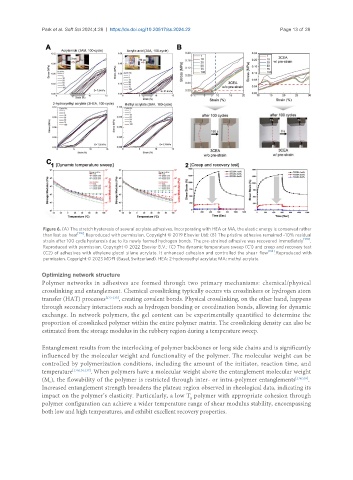
                Figure 6. (A) The stretch hysteresis of several acrylate adhesives. Incorporating with HEA or MA, the elastic energy is conserved rather
                than lost as  heat [126] . Reproduced with permission. Copyright © 2019 Elsevier Ltd; (B) The pristine adhesive remained ~10% residual
                strain after 100 cycle hysteresis due to its newly formed hydrogen bonds. The pre-strained adhesive was recovered  immediately [128] .
                Reproduced with permission. Copyright © 2022 Elsevier B.V.; (C) The dynamic temperature sweep (C1) and creep and recovery test
                (C2) of adhesives with ethylene glycol silane acrylate. It enhanced cohesion and controlled the shear  flow [132] . Reproduced with
                permission. Copyright © 2023 MDPI (Basel, Switzerland). HEA: 2-hydroxyethyl acrylate; MA: methyl acrylate.

               Optimizing network structure
               Polymer networks in adhesives are formed through two primary mechanisms: chemical/physical
               crosslinking and entanglement. Chemical crosslinking typically occurs via crosslinkers or hydrogen atom
               transfer (HAT) processes [133-135] , creating covalent bonds. Physical crosslinking, on the other hand, happens
               through secondary interactions such as hydrogen bonding or coordination bonds, allowing for dynamic
               exchange. In network polymers, the gel content can be experimentally quantified to determine the
               proportion of crosslinked polymer within the entire polymer matrix. The crosslinking density can also be
               estimated from the storage modulus in the rubbery region during a temperature sweep.

               Entanglement results from the interlocking of polymer backbones or long side chains and is significantly
               influenced by the molecular weight and functionality of the polymer. The molecular weight can be
               controlled by polymerization conditions, including the amount of the initiator, reaction time, and
               temperature [130,136,137] . When polymers have a molecular weight above the entanglement molecular weight
               (M ), the flowability of the polymer is restricted through inter- or intra-polymer entanglements [138,139] .
                  e
               Increased entanglement strength broadens the plateau region observed in rheological data, indicating its
               impact on the polymer’s elasticity. Particularly, a low T  polymer with appropriate cohesion through
                                                                 g
               polymer configuration can achieve a wider temperature range of shear modulus stability, encompassing
               both low and high temperatures, and exhibit excellent recovery properties.

