


Page 43 - Read Online
P. 43
Park et al. Soft Sci 2024;4:28  https://dx.doi.org/10.20517/ss.2024.22          Page 17 of 28


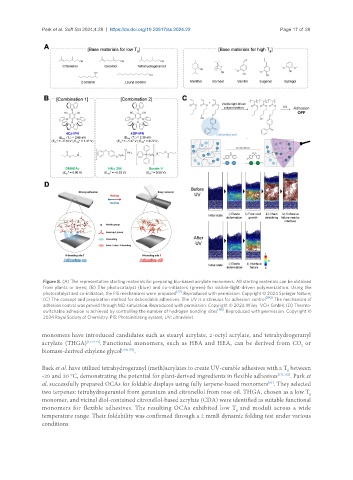
                Figure 8. (A) The representative starting materials for preparing bio-based acrylate monomers. All starting materials can be obtained
                from plants or trees; (B) The photocatalyst (blue) and co-initiators (green) for visible-light-driven polymerization. Using the
                                                            [27]
                photocatalyst and co-initiators, the PIS mechanisms were proposed  . Reproduced with permission. Copyright © 2024 Springer Nature;
                                                                                           [190]
                (C) The concept and preparation method for debondable adhesives. The UV is a stimulus for adhesion  control  . The mechanism of
                adhesion control was proved through MD simulation. Reproduced with permission. Copyright © 2024 Wiley VCH GmbH; (D) Thermo-
                switchable adhesion is achieved by controlling the number of hydrogen bonding  sites [196] . Reproduced with permission. Copyright ©
                2024 Royal Society of Chemistry. PIS: Photoinitiating system; UV: ultraviolet.

               monomers have introduced candidates such as stearyl acrylate, 2-octyl acrylate, and tetrahydrogeranyl
               acrylate (THGA) [172-174] . Functional monomers, such as HBA and HEA, can be derived from CO  or
                                                                                                       2
               biomass-derived ethylene glycol [158,175] .


               Baek et al. have utilized tetrahydrogeranyl (meth)acrylates to create UV-curable adhesives with a T  between
                                                                                                  g
               -20 and 30 °C, demonstrating the potential for plant-derived ingredients in flexible adhesives [171,172] . Park et
                                                                                           [91]
               al. successfully prepared OCAs for foldable displays using fully terpene-based monomers . They selected
               two terpenes: tetrahydrogeraniol from geranium and citronellol from rose oil. THGA, chosen as a low T
                                                                                                         g
               monomer, and vicinal diol-contained citronellol-based acrylate (CDA) were identified as suitable functional
               monomers for flexible adhesives. The resulting OCAs exhibited low T  and moduli across a wide
                                                                                 g
               temperature range. Their foldability was confirmed through a 2 mmR dynamic folding test under various
               conditions.

