


Page 46 - Read Online
P. 46
Page 20 of 28                            Park et al. Soft Sci 2024;4:28  https://dx.doi.org/10.20517/ss.2024.22


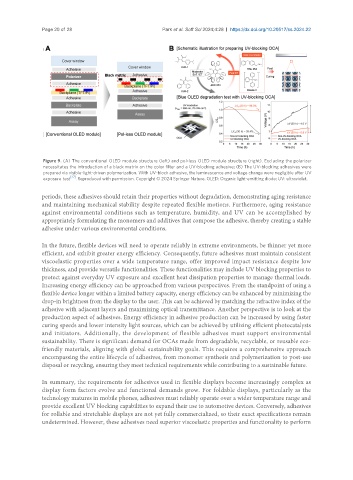
                Figure 9. (A) The conventional OLED module structure (left) and pol-less OLED module structure (right). Excluding the polarizer
                necessitates the introduction of a black matrix on the color filter and a UV-blocking adhesive; (B) The UV-blocking adhesives were
                prepared via visible-light-driven polymerization. With UV-block adhesive, the luminescence and voltage change were negligible after UV
                         [27]
                exposure test  . Reproduced with permission. Copyright © 2024 Springer Nature. OLED: Organic light-emitting diode; UV: ultraviolet.
               periods, these adhesives should retain their properties without degradation, demonstrating aging resistance
               and maintaining mechanical stability despite repeated flexible motions. Furthermore, aging resistance
               against environmental conditions such as temperature, humidity, and UV can be accomplished by
               appropriately formulating the monomers and additives that compose the adhesive, thereby creating a stable
               adhesive under various environmental conditions.


               In the future, flexible devices will need to operate reliably in extreme environments, be thinner yet more
               efficient, and exhibit greater energy efficiency. Consequently, future adhesives must maintain consistent
               viscoelastic properties over a wide temperature range, offer improved impact resistance despite low
               thickness, and provide versatile functionalities. These functionalities may include UV blocking properties to
               protect against everyday UV exposure and excellent heat dissipation properties to manage thermal loads.
               Increasing energy efficiency can be approached from various perspectives. From the standpoint of using a
               flexible device longer within a limited battery capacity, energy efficiency can be enhanced by minimizing the
               drop-in brightness from the display to the user. This can be achieved by matching the refractive index of the
               adhesive with adjacent layers and maximizing optical transmittance. Another perspective is to look at the
               production aspect of adhesives. Energy efficiency in adhesive production can be increased by using faster
               curing speeds and lower intensity light sources, which can be achieved by utilizing efficient photocatalysts
               and initiators. Additionally, the development of flexible adhesives must support environmental
               sustainability. There is significant demand for OCAs made from degradable, recyclable, or reusable eco-
               friendly materials, aligning with global sustainability goals. This requires a comprehensive approach
               encompassing the entire lifecycle of adhesives, from monomer synthesis and polymerization to post-use
               disposal or recycling, ensuring they meet technical requirements while contributing to a sustainable future.


               In summary, the requirements for adhesives used in flexible displays become increasingly complex as
               display form factors evolve and functional demands grow. For foldable displays, particularly as the
               technology matures in mobile phones, adhesives must reliably operate over a wider temperature range and
               provide excellent UV blocking capabilities to expand their use to automotive devices. Conversely, adhesives
               for rollable and stretchable displays are not yet fully commercialized, so their exact specifications remain
               undetermined. However, these adhesives need superior viscoelastic properties and functionality to perform

