


Page 36 - Read Online
P. 36
Page 10 of 28                            Park et al. Soft Sci 2024;4:28  https://dx.doi.org/10.20517/ss.2024.22


                                                                                            [90]
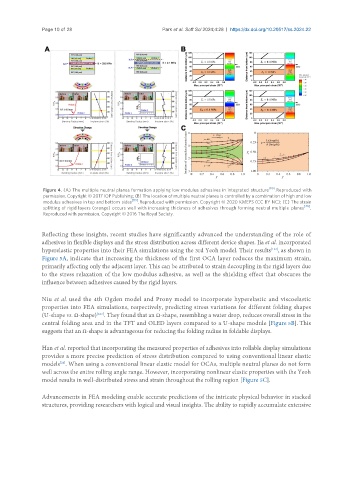
                Figure 4. (A) The multiple neutral planes formation applying low modulus adhesives in integrated  structure  . Reproduced with
                permission. Copyright © 2017 IOP Publishing; (B) The location of multiple neutral planes is controlled by a combination of high and low
                modulus adhesives in top and bottom  sides [119] . Reproduced with permission. Copyright © 2020 KMEPS (CC BY NC); (C) The strain
                splitting of rigid layers (orange) occurs well with increasing thickness of adhesives through forming neutral multiple  planes [40] .
                Reproduced with permission. Copyright © 2016 The Royal Society.

               Reflecting these insights, recent studies have significantly advanced the understanding of the role of
               adhesives in flexible displays and the stress distribution across different device shapes. Jia et al. incorporated
               hyperelastic properties into their FEA simulations using the 3rd Yeoh model. Their results , as shown in
                                                                                            [122]
               Figure 5A, indicate that increasing the thickness of the first OCA layer reduces the maximum strain,
               primarily affecting only the adjacent layer. This can be attributed to strain decoupling in the rigid layers due
               to the stress relaxation of the low modulus adhesive, as well as the shielding effect that obscures the
               influence between adhesives caused by the rigid layers.

               Niu et al. used the 4th Ogden model and Prony model to incorporate hyperelastic and viscoelastic
               properties into FEA simulations, respectively, predicting stress variations for different folding shapes
               (U-shape vs. Ω-shape) . They found that an Ω-shape, resembling a water drop, reduces overall stress in the
                                  [123]
               central folding area and in the TFT and OLED layers compared to a U-shape module [Figure 5B]. This
               suggests that an Ω-shape is advantageous for reducing the folding radius in foldable displays.

               Han et al. reported that incorporating the measured properties of adhesives into rollable display simulations
               provides a more precise prediction of stress distribution compared to using conventional linear elastic
                     [26]
               models . When using a conventional linear elastic model for OCAs, multiple neutral planes do not form
               well across the entire rolling angle range. However, incorporating nonlinear elastic properties with the Yeoh
               model results in well-distributed stress and strain throughout the rolling region [Figure 5C].


               Advancements in FEA modeling enable accurate predictions of the intricate physical behavior in stacked
               structures, providing researchers with logical and visual insights. The ability to rapidly accumulate extensive

