


Page 32 - Read Online
P. 32
Page 6 of 28                             Park et al. Soft Sci 2024;4:28  https://dx.doi.org/10.20517/ss.2024.22

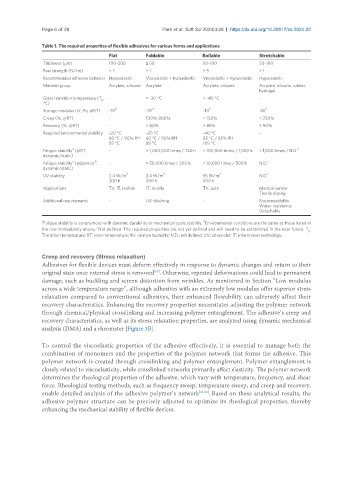
               Table 1. The required properties of flexible adhesives for various forms and applications
                                      Flat                          Foldable                                   Rollable                                    Stretchable
                Thickness (μm)        100~200     ≤ 50               50~100             50~100
                Peel strength (N/cm)  > 7         > 1                > 5                > 1
                Recommended adhesive behavior Hyperelastic  Viscoelastic + hyperelastic  Viscoelastic + hyperelastic  Hyperelastic
                Material group        Acrylate, silicone  Acrylate   Acrylate, silicone  Acrylate, silicone, rubber,
                                                                                        hydrogel
                Glass transition temperature (T , g  -  < -30 °C     < -40 °C           -
                °C)
                Storage modulus (G’, Pa, @RT)  ~10 6  ~10 4          ~10 5              ~10 4
                Creep (%, @RT)        -           100%~200%          > 150%             > 250%
                Recovery (%, @RT)     -           > 80%              > 85%              > 90%
                Required environmental stability  -20 °C   -20 °C    -40 °C             -
                                      60 °C / 90% RH   60 °C / 90% RH   85 °C / 85% RH
                                      85 °C       85 °C              105 °C
                         a                                                                           c
                Fatigue stability  (@RT,   -      > 1,000,000 times / 720 h  > 100,000 times / 1,000 h  > 1,000 times / N.D.
                dynamic/static)
                         a       b                                                         c
                Fatigue stability  (@Environ. ,   -  > 50,000 times / 300 h  > 10,000 times / 500 h  N.D.
                dynamic/static)
                                            2           2                  2               c
                UV stability          2.4 W/m     2.4 W/m            55 W/m             N.D.
                                      300 h       300 h              500 h
                Applications          TV, IT, mobile  IT, mobile     TV, auto           Medical sensor
                                                                                        Textile display
                Additional requirements  -        UV-blocking        -                  Biocompatibility
                                                                                        Water-resistance
                                                                                        Detachable
               a                                                      b
                Fatigue stability is synonymous with dynamic durability or mechanical cycle stability;  Environmental conditions are the same as those listed in
                                  c
               the row immediately above;  Not defined. The required properties are not yet defined and will need to be established in the near future. T :
                                                                                                         g
               Transition temperature; RT: room temperature; RH: relative humidity; N.D.: not defined; UV: ultraviolet; IT: information technology.

               Creep and recovery (Stress relaxation)
               Adhesives for flexible devices must deform effectively in response to dynamic changes and return to their
               original state once external stress is removed . Otherwise, repeated deformations could lead to permanent
                                                     [92]
               damage, such as buckling and screen distortion from wrinkles. As mentioned in Section “Low modulus
               across a wide temperature range”, although adhesives with an extremely low modulus offer superior stress
               relaxation compared to conventional adhesives, their enhanced flowability can adversely affect their
               recovery characteristics. Enhancing the recovery properties necessitates adjusting the polymer network
               through chemical/physical crosslinking and increasing polymer entanglement. The adhesive’s creep and
               recovery characteristics, as well as its stress relaxation properties, are analyzed using dynamic mechanical
               analysis (DMA) and a rheometer [Figure 3B].


               To control the viscoelastic properties of the adhesive effectively, it is essential to manage both the
               combination of monomers and the properties of the polymer network that forms the adhesive. This
               polymer network is created through crosslinking and polymer entanglement. Polymer entanglement is
               closely related to viscoelasticity, while crosslinked networks primarily affect elasticity. The polymer network
               determines the rheological properties of the adhesive, which vary with temperature, frequency, and shear
               force. Rheological testing methods, such as frequency sweep, temperature sweep, and creep and recovery,
               enable detailed analysis of the adhesive polymer’s network [93-99] . Based on these analytical results, the
               adhesive polymer structure can be precisely adjusted to optimize its rheological properties, thereby
               enhancing the mechanical stability of flexible devices.

