


Page 29 - Read Online
P. 29
Park et al. Soft Sci 2024;4:28  https://dx.doi.org/10.20517/ss.2024.22           Page 3 of 28


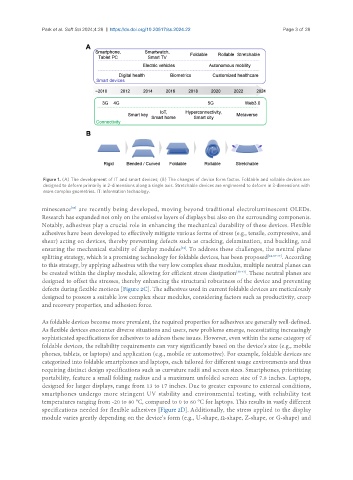
                Figure 1. (A) The development of IT and smart devices; (B) The changes of device form factor. Foldable and rollable devices are
                designed to deform primarily in 2-dimensions along a single axis. Stretchable devices are engineered to deform in 3-dimensions with
                more complex geometries. IT: Information technology.

               minescence  are recently being developed, moving beyond traditional electroluminescent OLEDs.
                         [33]
               Research has expanded not only on the emissive layers of displays but also on the surrounding components.
               Notably, adhesives play a crucial role in enhancing the mechanical durability of these devices. Flexible
               adhesives have been developed to effectively mitigate various forms of stress (e.g., tensile, compressive, and
               shear) acting on devices, thereby preventing defects such as cracking, delamination, and buckling, and
                                                              [34]
               ensuring the mechanical stability of display modules . To address these challenges, the neutral plane
               splitting strategy, which is a promising technology for foldable devices, has been proposed [24,35-37] . According
               to this strategy, by applying adhesives with the very low complex shear modulus, multiple neutral planes can
               be created within the display module, allowing for efficient stress dissipation [38-42] . These neutral planes are
               designed to offset the stresses, thereby enhancing the structural robustness of the device and preventing
               defects during flexible motions [Figure 2C]. The adhesives used in current foldable devices are meticulously
               designed to possess a suitable low complex shear modulus, considering factors such as productivity, creep
               and recovery properties, and adhesion force.


               As foldable devices become more prevalent, the required properties for adhesives are generally well-defined.
               As flexible devices encounter diverse situations and users, new problems emerge, necessitating increasingly
               sophisticated specifications for adhesives to address these issues. However, even within the same category of
               foldable devices, the reliability requirements can vary significantly based on the device’s size (e.g., mobile
               phones, tablets, or laptops) and application (e.g., mobile or automotive). For example, foldable devices are
               categorized into foldable smartphones and laptops, each tailored for different usage environments and thus
               requiring distinct design specifications such as curvature radii and screen sizes. Smartphones, prioritizing
               portability, feature a small folding radius and a maximum unfolded screen size of 7.8 inches. Laptops,
               designed for larger displays, range from 13 to 17 inches. Due to greater exposure to external conditions,
               smartphones undergo more stringent UV stability and environmental testing, with reliability test
               temperatures ranging from -20 to 80 °C, compared to 0 to 60 °C for laptops. This results in vastly different
               specifications needed for flexible adhesives [Figure 2D]. Additionally, the stress applied to the display
               module varies greatly depending on the device’s form (e.g., U-shape, Ω-shape, Z-shape, or G-shape) and

