


Page 30 - Read Online
P. 30
Page 4 of 28                             Park et al. Soft Sci 2024;4:28  https://dx.doi.org/10.20517/ss.2024.22


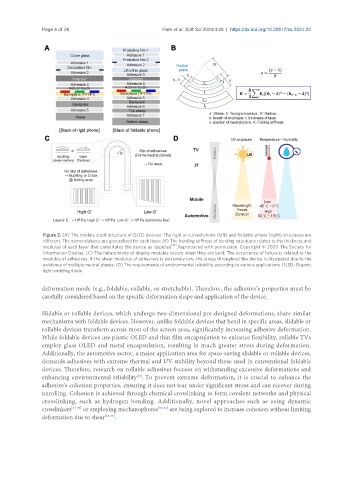
                Figure 2. (A) The module stack structure of OLED devices. The rigid or curved phone (left) and foldable phone (right) structures are
                different. The nomenclatures are generalized for each layer; (B) The bending stiffness of bending structures relates to the thickness and
                modulus of each layer that constitutes the device as  depicted [15] . Reproduced with permission. Copyright © 2020 The Society for
                Information Display; (C) The failure mode of display modules occurs when they are bent. The occurrence of failure is related to the
                modulus of adhesives. If the shear modulus of adhesives is extremely low, the stress throughout the device is dissipated due to the
                existence of multiple neutral planes; (D) The requirements of environmental reliability according to various applications. OLED: Organic
                light-emitting diode.


               deformation mode (e.g., foldable, rollable, or stretchable). Therefore, the adhesive’s properties must be
               carefully considered based on the specific deformation shape and application of the device.

               Slidable or rollable devices, which undergo two-dimensional pre-designed deformations, share similar
               mechanisms with foldable devices. However, unlike foldable devices that bend in specific areas, slidable or
               rollable devices transform across most of the screen area, significantly increasing adhesive deformation.
               While foldable devices use plastic OLED and thin film encapsulation to enhance flexibility, rollable TVs
               employ glass OLED and metal encapsulation, resulting in much greater stress during deformation.
               Additionally, the automotive sector, a major application area for space-saving slidable or rollable devices,
               demands adhesives with extreme thermal and UV stability beyond those used in conventional foldable
               devices. Therefore, research on rollable adhesives focuses on withstanding excessive deformations and
                                               [43]
               enhancing environmental reliability . To prevent extreme deformation, it is crucial to enhance the
               adhesive's cohesion properties, ensuring it does not tear under significant stress and can recover during
               unrolling. Cohesion is achieved through chemical crosslinking to form covalent networks and physical
               crosslinking, such as hydrogen bonding. Additionally, novel approaches such as using dynamic
               crosslinkers [44-49]  or employing mechanophores [50-52]  are being explored to increase cohesion without limiting
               deformation due to shear [53-55] .

