


Page 33 - Read Online
P. 33
Park et al. Soft Sci 2024;4:28  https://dx.doi.org/10.20517/ss.2024.22           Page 7 of 28


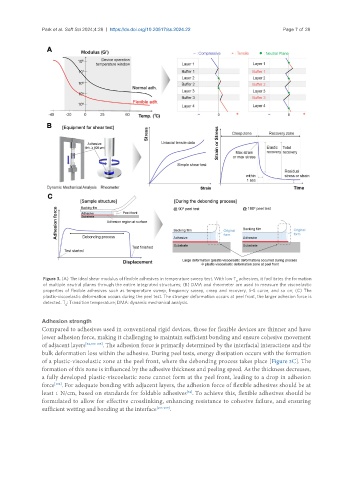
                Figure 3. (A) The ideal shear modulus of flexible adhesives in temperature sweep test. With low T  adhesives, it facilitates the formation
                                                                                 g
                of multiple neutral planes through the entire integrated structures; (B) DMA and rheometer are used to measure the viscoelastic
                properties  of  flexible  adhesives  such  as  temperature  sweep,  frequency  sweep,  creep  and  recovery,  S-S  curve,  and  so  on;  (C)  The
                plastic-viscoelastic deformation occurs during the peel test. The stronger deformation occurs at peel front, the larger adhesion force is
                detected. T : Transition temperature; DMA: dynamic mechanical analysis.
                       g

               Adhesion strength
               Compared to adhesives used in conventional rigid devices, those for flexible devices are thinner and have
               lower adhesion force, making it challenging to maintain sufficient bonding and ensure cohesive movement
               of adjacent layers [34,100-103] . The adhesion force is primarily determined by the interfacial interactions and the
               bulk deformation loss within the adhesive. During peel tests, energy dissipation occurs with the formation
               of a plastic-viscoelastic zone at the peel front, where the debonding process takes place [Figure 3C]. The
               formation of this zone is influenced by the adhesive thickness and peeling speed. As the thickness decreases,
               a fully developed plastic-viscoelastic zone cannot form at the peel front, leading to a drop in adhesion
               force . For adequate bonding with adjacent layers, the adhesion force of flexible adhesives should be at
                   [104]
               least 1 N/cm, based on standards for foldable adhesives . To achieve this, flexible adhesives should be
                                                                [34]
               formulated to allow for effective crosslinking, enhancing resistance to cohesive failure, and ensuring
               sufficient wetting and bonding at the interface [105-109] .

