


Page 69 - Read Online
P. 69
Page 8 of 13                             Shin et al. Soft Sci 2024;4:22  https://dx.doi.org/10.20517/ss.2024.03


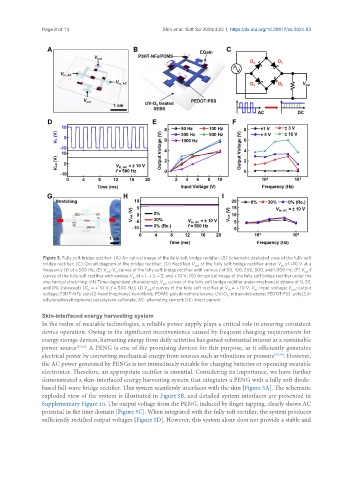
                Figure 3. Fully soft bridge rectifier. (A) An optical image of the fully soft bridge rectifier; (B) Schematic exploded view of the fully soft
                bridge rectifier; (C) Circuit diagram of the bridge rectifier; (D) Rectified V  of the fully soft bridge rectifier under V  of ±10 V at a
                                                                                                in
                                                                   out
                frequency (f) of a 500 Hz; (E) V -V  curves of the fully soft bridge rectifier with various f of 50, 100, 200, 500, and 1,000 Hz; (F) V -f
                                        in
                                     out
                                                                                                        out
                curves of the fully soft rectifier with various V  of ± 1, ± 3, ± 5, and ± 10 V; (G) An optical image of the fully soft bridge rectifier under the
                                              in
                mechanical stretching; (H) Time-dependent characteristic V  curves of the fully soft bridge rectifier under mechanical strains of 0, 30,
                                                        out
                and 0% (released) (V  = ± 10 V, f = 500 Hz); (I) V -f curves of the fully soft rectifier at V  = ± 10 V. V : Input voltage; V : output
                               in
                                                                                                   out
                                                                                       in
                                                   out
                                                                              in
                voltage; P3HT-NFs: poly(3-hexylthiophene) nanofibrils; PDMS: polydimethylsiloxane; UV-O : ultraviolet-ozone; PEDOT:PSS: poly(3,4-
                                                                              3
                ethylenedioxythiophene) polystyrene sulfonate; AC: alternating current; DC: direct current.
               Skin-interfaced energy harvesting system
               In the realm of wearable technologies, a reliable power supply plays a critical role in ensuring consistent
               device operation. Owing to the significant inconvenience caused by frequent charging requirements for
               energy storage devices, harvesting energy from daily activities has gained substantial interest as a sustainable
               power source [37,38] . A PENG is one of the promising devices for this purpose, as it efficiently generates
               electrical power by converting mechanical energy from sources such as vibrations or pressure [39,40] . However,
               the AC power generated by PENGs is not immediately suitable for charging batteries or operating wearable
               electronics. Therefore, an appropriate rectifier is essential. Considering its importance, we have further
               demonstrated a skin-interfaced energy harvesting system that integrates a PENG with a fully soft diode-
               based full-wave bridge rectifier. This system seamlessly interfaces with the skin [Figure 5A]. The schematic
               exploded view of the system is illustrated in Figure 5B, and detailed system interfaces are presented in
               Supplementary Figure 10. The output voltage from the PENG, induced by finger tapping, clearly shows AC
               potential in the time domain [Figure 5C]. When integrated with the fully soft rectifier, the system produces
               sufficiently rectified output voltages [Figure 5D]. However, this system alone does not provide a stable and

