


Page 66 - Read Online
P. 66
Shin et al. Soft Sci 2024;4:22  https://dx.doi.org/10.20517/ss.2024.03           Page 5 of 13


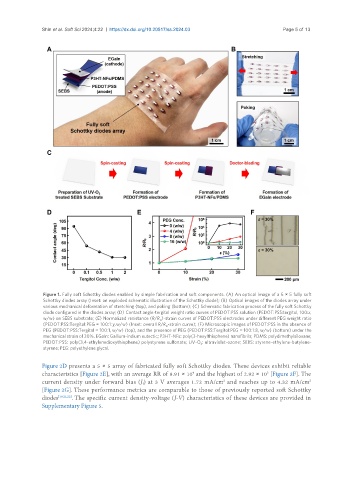
                Figure 1. Fully soft Schottky diodes enabled by simple fabrication and soft components. (A) An optical image of a 5 × 5 fully soft
                Schottky diodes array (Inset: an exploded schematic illustration of the Schottky diode); (B) Optical images of the diodes array under
                various mechanical deformation of stretching (top), and poking (bottom); (C) Schematic fabrication process of the fully soft Schottky
                diode configured in the diodes array; (D) Contact angle-tergitol weight ratio curves of PEDOT:PSS solution (PEDOT:PSS:tergitol, 100:x,
                w/w) on SEBS substrate; (E) Normalized resistance (R/R )-strain curves of PEDOT:PSS electrodes under different PEG weight ratio
                                                       0
                (PEDOT:PSS:Tergitol:PEG = 100:1:y, w/w) (Inset: overall R/R -strain curve); (F) Microscopic images of PEDOT:PSS in the absence of
                                                         0
                PEG (PEDOT:PSS:Tergitol = 100:1, w/w) (top), and the presence of PEG (PEDOT:PSS:Tergitol:PEG = 100:1:8, w/w) (bottom) under the
                mechanical strain of 30%. EGaIn: Gallium-indium eutectic; P3HT-NFs: poly(3-hexylthiophene) nanofibrils; PDMS: polydimethylsiloxane;
                PEDOT:PSS: poly(3,4-ethylenedioxythiophene) polystyrene sulfonate; UV-O : ultraviolet-ozone; SEBS: styrene-ethylene-butylene-
                                                                     3
                styrene; PEG: polyethylene glycol.
               Figure 2D presents a 5 × 5 array of fabricated fully soft Schottky diodes. These devices exhibit reliable
               characteristics [Figure 2E], with an average RR of 8.91 × 10  and the highest of 2.92 × 10  [Figure 2F]. The
                                                                  4
                                                                                           5
               current density under forward bias (J ) at 3 V averages 1.72 mA/cm  and reaches up to 4.32 mA/cm
                                                                            2
                                                                                                         2
                                                 f
               [Figure 2G]. These performance metrics are comparable to those of previously reported soft Schottky
               diodes [19,21,22] . The specific current density-voltage (J-V) characteristics of these devices are provided in
               Supplementary Figure 5.

