


Page 67 - Read Online
P. 67
Page 6 of 13                             Shin et al. Soft Sci 2024;4:22  https://dx.doi.org/10.20517/ss.2024.03


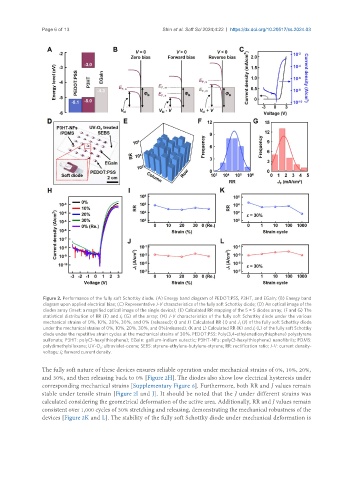
                Figure 2. Performance of the fully soft Schottky diode. (A) Energy band diagram of PEDOT:PSS, P3HT, and EGaIn; (B) Energy band
                diagram upon applied electrical bias; (C) Representative J-V characteristics of the fully soft Schottky diode; (D) An optical image of the
                diodes array (inset: a magnified optical image of the single device); (E) Calculated RR mapping of the 5 × 5 diodes array; (F and G) The
                statistical distribution of RR (F) and J  (G) of the array; (H) J-V characteristics of the fully soft Schottky diode under the various
                                          f
                mechanical strains of 0%, 10%, 20%, 30%, and 0% (released); (I and J) Calculated RR (I) and J  (J) of the fully soft Schottky diode
                                                                                  f
                under the mechanical strains of 0%, 10%, 20%, 30%, and 0%(released); (K and L) Calculated RR (K) and J  (L) of the fully soft Schottky
                                                                                       f
                diode under the repetitive strain cycles at the mechanical strains of 30%. PEDOT:PSS: Poly(3,4-ethylenedioxythiophene) polystyrene
                sulfonate; P3HT: poly(3-hexylthiophene); EGaIn: gallium-indium eutectic; P3HT-NFs: poly(3-hexylthiophene) nanofibrils; PDMS:
                polydimethylsiloxane; UV-O : ultraviolet-ozone; SEBS: styrene-ethylene-butylene-styrene; RR: rectification ratio; J-V: current density-
                                   3
                voltage; J : forward current density.
                      f
               The fully soft nature of these devices ensures reliable operation under mechanical strains of 0%, 10%, 20%,
               and 30%, and then releasing back to 0% [Figure 2H]. The diodes also show low electrical hysteresis under
               corresponding mechanical strains [Supplementary Figure 6]. Furthermore, both RR and J values remain
               stable under tensile strain [Figure 2I and J]. It should be noted that the J under different strains was
               calculated considering the geometrical deformation of the active area. Additionally, RR and J values remain
               consistent over 1,000 cycles of 30% stretching and releasing, demonstrating the mechanical robustness of the
               devices [Figure 2K and L]. The stability of the fully soft Schottky diode under mechanical deformation is

