


Page 11 - Read Online
P. 11
Fan et al. Soft Sci 2024;4:11  https://dx.doi.org/10.20517/ss.2023.47            Page 9 of 16


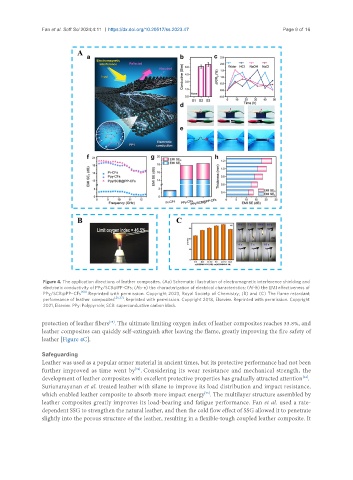
                Figure 4. The application directions of leather composites. (Aa) Schematic illustration of electromagnetic interference shielding and
                electronic conductivity of PPy/SCB@PP-CFs; (Ab-e) the characterization of electrical characteristics; (Af-h) the EMI effectiveness of
                PPy/SCB@PP-CFs [64] . Reprinted with permission. Copyright 2023, Royal Society of Chemistry; (B) and (C) The flame retardant
                performance of leather  composites [25,37] . Reprinted with permission. Copyright 2018, Elsevier. Reprinted with permission. Copyright
                2021, Elsevier. PPy: Polypyrrole; SCB: superconductive carbon black.

                                      [25]
               protection of leather fibers . The ultimate limiting oxygen index of leather composites reaches 33.8%, and
               leather composites can quickly self-extinguish after leaving the flame, greatly improving the fire safety of
               leather [Figure 4C].

               Safeguarding
               Leather was used as a popular armor material in ancient times, but its protective performance had not been
                                               [74]
               further improved as time went by . Considering its wear resistance and mechanical strength, the
               development of leather composites with excellent protective properties has gradually attracted attention .
                                                                                                       [24]
               Surianarayanan et al. treated leather with silane to improve its load distribution and impact resistance,
               which enabled leather composite to absorb more impact energy . The multilayer structure assembled by
                                                                      [75]
               leather composites greatly improves its load-bearing and fatigue performance. Fan et al. used a rate-
               dependent SSG to strengthen the natural leather, and then the cold flow effect of SSG allowed it to penetrate
               slightly into the porous structure of the leather, resulting in a flexible-tough coupled leather composite. It

