


Page 14 - Read Online
P. 14
Page 12 of 16                            Fan et al. Soft Sci 2024;4:11  https://dx.doi.org/10.20517/ss.2023.47


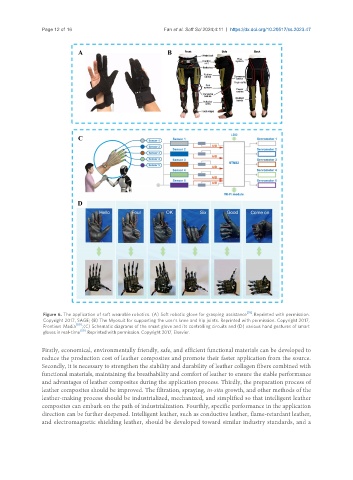
                Figure 6. The application of soft wearable robotics. (A) Soft robotic glove for grasping  assistance [79] . Reprinted with permission.
                Copyright 2017, SAGE; (B) The Myosuit for supporting the user’s knee and hip joints. Reprinted with permission. Copyright 2017,
                Frontiers  Media [80] ; (C) Schematic diagrams of the smart glove and its controlling circuits and (D) various hand gestures of smart
                gloves in real-time [50] . Reprinted with permission. Copyright 2017, Elsevier.

               Firstly, economical, environmentally friendly, safe, and efficient functional materials can be developed to
               reduce the production cost of leather composites and promote their faster application from the source.
               Secondly, it is necessary to strengthen the stability and durability of leather collagen fibers combined with
               functional materials, maintaining the breathability and comfort of leather to ensure the stable performance
               and advantages of leather composites during the application process. Thirdly, the preparation process of
               leather composites should be improved. The filtration, spraying, in-situ growth, and other methods of the
               leather-making process should be industrialized, mechanized, and simplified so that intelligent leather
               composites can embark on the path of industrialization. Fourthly, specific performance in the application
               direction can be further deepened. Intelligent leather, such as conductive leather, flame-retardant leather,
               and electromagnetic shielding leather, should be developed toward similar industry standards, and a

