


Page 6 - Read Online
P. 6
Page 4 of 16                             Fan et al. Soft Sci 2024;4:11  https://dx.doi.org/10.20517/ss.2023.47


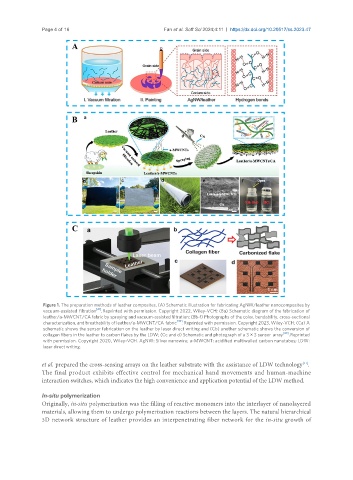
                Figure 1. The preparation methods of leather composites. (A) Schematic illustration for fabricating AgNW/leather nanocomposites by
                vacuum-assisted  filtration [41] . Reprinted with permission. Copyright 2022, Wiley-VCH; (Ba) Schematic diagram of the fabrication of
                leather/a-MWCNT/CA fabric by spraying and vacuum-assisted filtration; (Bb-f) Photographs of the color, bendability, cross-sectional
                characterization, and breathability of leather/a-MWCNT/CA fabric [45] . Reprinted with permission. Copyright 2023, Wiley-VCH; (Ca) A
                schematic shows the sensor fabrication on the leather by laser direct writing and (Cb) another schematic shows the conversion of
                collagen fibers in the leather to carbon flakes by the LDW; (Cc and d) Schematic and photograph of a 3 × 3 sensor array [49] . Reprinted
                with permission. Copyright 2020, Wiley-VCH. AgNW: Silver nanowire; a-MWCNT: acidified multiwalled carbon nanotubes; LDW:
                laser direct writing.


                                                                                                       [21]
               et al. prepared the cross-sensing arrays on the leather substrate with the assistance of LDW technology .
               The final product exhibits effective control for mechanical hand movements and human-machine
               interaction switches, which indicates the high convenience and application potential of the LDW method.


               In-situ polymerization
               Originally, in-situ polymerization was the filling of reactive monomers into the interlayer of nanolayered
               materials, allowing them to undergo polymerization reactions between the layers. The natural hierarchical
               3D network structure of leather provides an interpenetrating fiber network for the in-situ growth of

