


Page 88 - Read Online
P. 88
Page 8 of 26                            Yang et al. Soft Sci 2024;4:9   https://dx.doi.org/10.20517/ss.2023.43

               Fe O  nanoparticles) have significantly increased the tumor ablation efficiency and preserved post-thaw
                   4
                 3
               cellular viability. LMs, with high thermal conductivity and superior transformability, are prospective
               alternatives to conventional rigid adjuvants, and the thermal properties of Ga-based LMs and other
               common inorganic and organic substances are listed in Table 2. In this section, two modes to enhance heat
               transfer of biomaterials and tremendous stimuli-responsive self-heating effects of LMs will be presented.

               Enhanced heat transfer
               The inferior thermal conductivity of biomaterials is an inevitable barrier to the regulation of their
               temperature with rapid response, wide range, and high precision. Over the past two decades, our laboratory
               has extensively studied the LMs as coolants [67-70]  or TIMs [31-33,71] , which has confirmed their ability to enhance
               heat transfer and diminish contact thermal resistance [Figure 3A]. For biomedical applications, Wang et al.
               prepared EGaIn-based composite pastes to actualize thermal therapy for subcutaneous tumors [56,72] . The
               modified LMs were tightly adhesive to skins and increased the heat penetration into tumor tissues
               according to the simulation results. Hou et al. testified to the effectiveness of the probe cryoablation and
               manifested the increased “cold energy” transfer enabled by conformally coated LM paste in both numerical
                                       [53]
               simulation and experiments .

               In addition to the bulk LM-enabled heat transfer improvement, the idea of “nano-cryosurgery” has been
               proposed, whereby solutions containing nanoparticles (i.e., nanofluids) are injected into the tumor site to
               enhance heat transfer, aggravate freeze damage, and regulate ice ball formation. For a solution containing
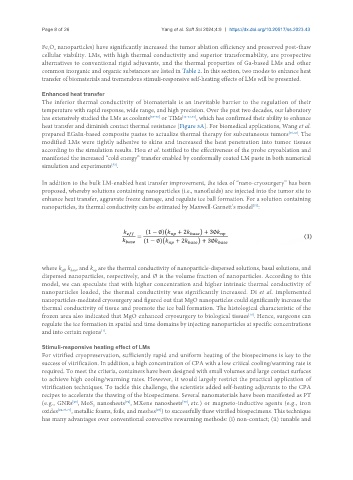
               nanoparticles, its thermal conductivity can be estimated by Maxwell-Garnett’s model :
                                                                                      [73]


               where k , k , and k  are the thermal conductivity of nanoparticle-dispersed solutions, basal solutions, and
                                np
                         base
                      eff
               dispersed nanoparticles, respectively, and Ø is the volume fraction of nanoparticles. According to this
               model, we can speculate that with higher concentration and higher intrinsic thermal conductivity of
               nanoparticles loaded, the thermal conductivity was significantly increased. Di et al. implemented
               nanoparticles-mediated cryosurgery and figured out that MgO nanoparticles could significantly increase the
               thermal conductivity of tissue and promote the ice ball formation. The histological characteristic of the
               frozen area also indicated that MgO enhanced cryosurgery to biological tissues . Hence, surgeons can
                                                                                     [10]
               regulate the ice formation in spatial and time domains by injecting nanoparticles at specific concentrations
               and into certain regions .
                                   [1]

               Stimuli-responsive heating effect of LMs
               For vitrified cryopreservation, sufficiently rapid and uniform heating of the biospecimens is key to the
               success of vitrification. In addition, a high concentration of CPA with a low critical cooling/warming rate is
               required. To meet the criteria, containers have been designed with small volumes and large contact surfaces
               to achieve high cooling/warming rates. However, it would largely restrict the practical application of
               vitrification techniques. To tackle this challenge, the scientists added self-heating adjuvants to the CPA
               recipes to accelerate the thawing of the biospecimens. Several nanomaterials have been manifested as PT
                                           [74]
               (e.g., GNRs , MoS  nanosheets , MXene nanosheets , etc.) or magneto-inductive agents (e.g., iron
                         [25]
                                                               [75]
                                2
               oxides [24,76,77] , metallic foams, foils, and meshes ) to successfully thaw vitrified biospecimens. This technique
                                                      [26]
               has many advantages over conventional convective rewarming methods: (i) non-contact; (ii) tunable and

