


Page 87 - Read Online
P. 87
Yang et al. Soft Sci 2024;4:9   https://dx.doi.org/10.20517/ss.2023.43           Page 7 of 26

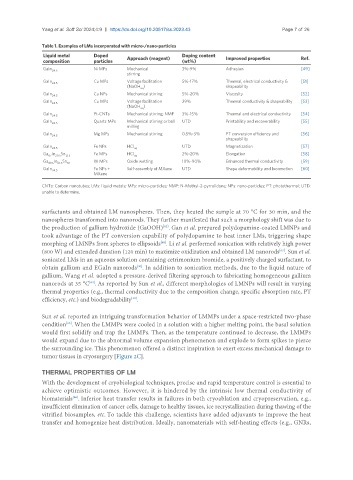
               Table 1. Examples of LMs incorporated with micro-/nano-particles
                Liquid metal     Doped      Approach (reagent)  Doping content   Improved properties  Ref.
                composition      particles                    (wt%)
                GaIn             Ni MPs     Mechanical        3%-9%          Adhesion                 [49]
                   24.5
                                            stirring
                GaIn             Cu MPs     Voltage facilitation   5%-17%    Thermal, electrical conductivity &   [51]
                   24.5
                                            (NaOH )                          shapeability
                                                aq
                GaIn             Cu NPs     Mechanical stirring  5%-20%      Viscosity                [52]
                   24.5
                GaIn 24.5        Cu MPs     Voltage facilitation   29%       Thermal conductivity & shapeability  [53]
                                            (NaOH )
                                                aq
                GaIn 24.5        Pt-CNTs    Mechanical stirring; NMP  3%-15%  Thermal and electrical conductivity  [54]
                GaIn 24.5        Quartz MPs  Mechanical stirring or ball   UTD  Printability and recoverability  [55]
                                            milling
                GaIn 24.5        Mg MPs     Mechanical stirring  0.5%-3%     PT conversion efficiency and   [56]
                                                                             shapeability
                GaIn 24.5        Fe NPs     HCl aq            UTD            Magnetization            [57]
                Ga In  Sn        Fe MPs     HCl               2%-20%         Elongation               [58]
                 67  20.5  12.5               aq
                Ga 68.5 In 21.5 Sn 10  W MPs  Oxide wetting   10%-90%        Enhanced thermal conductivity  [59]
                GaIn             Fe NPs +   Self-assembly of MXene  UTD      Shape deformability and locomotion  [60]
                   24.5
                                 MXene
               CNTs: Carbon nanotubes; LMs: liquid metals; MPs: micro-particles; NMP: N-Methyl-2-pyrrolidone; NPs: nano-particles; PT: photothermal; UTD:
               unable to determine.


               surfactants and obtained LM nanospheres. Then, they heated the sample at 70 °C for 30 min, and the
               nanospheres transformed into nanorods. They further manifested that such a morphology shift was due to
                                                        [62]
               the production of gallium hydroxide (GaOOH) . Gan et al. prepared polydopamine-coated LMNPs and
               took advantage of the PT conversion capability of polydopamine to heat inner LMs, triggering shape
               morphing of LMNPs from spheres to ellipsoids . Li et al. performed sonication with relatively high power
                                                       [48]
               (800 W) and extended duration (120 min) to maximize oxidization and obtained LM nanorods . Sun et al.
                                                                                               [63]
               sonicated LMs in an aqueous solution containing cetrimonium bromide, a positively charged surfactant, to
               obtain gallium and EGaIn nanorods . In addition to sonication methods, due to the liquid nature of
                                               [40]
               gallium, Wang et al. adopted a pressure-derived filtering approach to fabricating homogeneous gallium
                               [64]
               nanorods at 35 °C . As reported by Sun et al., different morphologies of LMNPs will result in varying
               thermal properties (e.g., thermal conductivity due to the composition change, specific absorption rate, PT
                                             [40]
               efficiency, etc.) and biodegradability .

               Sun et al. reported an intriguing transformation behavior of LMMPs under a space-restricted two-phase
                       [65]
               condition . When the LMMPs were cooled in a solution with a higher melting point, the basal solution
               would first solidify and trap the LMMPs. Then, as the temperature continued to decrease, the LMMPs
               would expand due to the abnormal volume expansion phenomenon and explode to form spikes to pierce
               the surrounding ice. This phenomenon offered a distinct inspiration to exert excess mechanical damage to
               tumor tissues in cryosurgery [Figure 2C].


               THERMAL PROPERTIES OF LM
               With the development of cryobiological techniques, precise and rapid temperature control is essential to
               achieve optimistic outcomes. However, it is hindered by the intrinsic low thermal conductivity of
               biomaterials . Inferior heat transfer results in failures in both cryoablation and cryopreservation, e.g.,
                          [66]
               insufficient elimination of cancer cells, damage to healthy tissues, ice recrystallization during thawing of the
               vitrified biosamples, etc. To tackle this challenge, scientists have added adjuvants to improve the heat
               transfer and homogenize heat distribution. Ideally, nanomaterials with self-heating effects (e.g., GNRs,

