


Page 6 - Read Online
P. 6
Page 4 of 9                                 Wang. Soft Sci 2024;4:5  https://dx.doi.org/10.20517/ss.2023.44

               biocompatibility, stretchability, sufficient thinness, and mechanical durability. Notably, the epidermal
               electrode with a compliant and comfortable interface guarantees high-quality bioelectrical signals where a
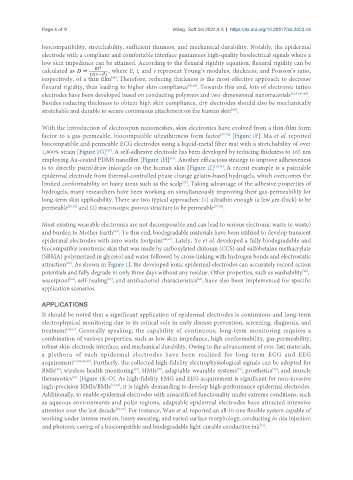
               low skin impedance can be attained. According to the flexural rigidity equation, flexural rigidity can be
                                    2
               calculated as D = 12(1-v ), where E, t, and ν represent Young’s modulus, thickness, and Poisson’s ratio,
               respectively, of a thin film . Therefore, reducing thickness is the most effective approach to decrease
                                      [44]
               flexural rigidity, thus leading to higher skin compliance [45,46] . Towards this end, lots of electronic tattoo
               electrodes have been developed based on conducting polymers and two-dimensional nanomaterials [10,37,47,48] .
               Besides reducing thickness to obtain high skin compliance, dry electrodes should also be mechanically
               stretchable and durable to secure continuous attachment on the human skin .
                                                                               [49]

               With the introduction of electrospun nanomeshes, skin electronics have evolved from a thin-film form
               factor to a gas-permeable, biocompatible ultrathinness form factor [50-52]  [Figure 1F]. Ma et al. reported
               biocompatible and permeable ECG electrodes using a liquid-metal fiber mat with a stretchability of over
                                     [53]
               1,800% strain [Figure 1G] . A self-adhesive electrode has been developed by reducing thickness to 165 nm
               employing Au-coated PDMS nanofilm [Figure 1H] . Another efficacious strategy to improve adhesiveness
                                                          [44]
               is to directly paint/draw inks/gels on the human skin [Figure 1I] [13,54] . A recent example is a paintable
               epidermal electrode from thermal-controlled phase change gelatin-based hydrogels, which overcomes the
                                                              [55]
               limited conformability on hairy areas such as the scalp . Taking advantage of the adhesive properties of
               hydrogels, many researchers have been working on simultaneously improving their gas-permeability for
               long-term skin applicability. There are two typical approaches: (1) ultrathin enough (a few µm-thick) to be
               permeable [20,56]  and (2) macroscopic porous structure to be permeable [57,58] .

               Most existing wearable electronics are not decomposable and can lead to serious electronic waste (e-waste)
                                       [59]
               and burden to Mother Earth . To this end, biodegradable materials have been utilized to develop transient
               epidermal electrodes with zero waste footprint [60,61] . Lately, Ye et al. developed a fully biodegradable and
               biocompatible ionotronic skin that was made by carboxylated chitosan (CCS) and sulfobetaine methacrylate
               (SBMA) polymerized in glycerol and water followed by cross-linking with hydrogen bonds and electrostatic
                       [62]
               attraction . As shown in Figure 1J, the developed ionic epidermal electrodes can accurately record action
               potentials and fully degrade in only three days without any residue. Other properties, such as washability ,
                                                                                                       [63]
                                     [65]
               waterproof , self-healing , and antibacterial characteristics , have also been implemented for specific
                                                                   [66]
                        [64]
               application scenarios.
               APPLICATIONS
               It should be noted that a significant application of epidermal electrodes is continuous and long-term
               electrophysical monitoring due to its critical role in early disease prevention, screening, diagnosis, and
               treatment [28,67] . Generally speaking, the capability of continuous, long-term monitoring requires a
               combination of various properties, such as low skin impedance, high conformability, gas-permeability,
               robust skin-electrode interface, and mechanical durability. Owing to the advancement of ever-fast materials,
               a  plethora  of  such  epidermal  electrodes  have  been  realized  for  long-term  ECG  and  EEG
               acquirement [44,55,68,69] . Furtherly, the collected high-fidelity electrophysiological signals can be adopted for
               BMIs , wireless health monitoring , HMIs , adaptable wearable systems , prosthetics , and muscle
                                                      [70]
                                              [18]
                    [55]
                                                                                 [71]
                                                                                             [72]
               theranostics  [Figure 1K-O]. As high-fidelity EMG and EEG acquirement is significant for non-invasive
                         [21]
               high-precision HMIs/BMIs [12,72] , it is highly demanding to develop high-performance epidermal electrodes.
               Additionally, to enable epidermal electrodes with unsacrificed functionality under extreme conditions, such
               as aqueous environments and polar regions, adaptable epidermal electrodes have attracted intensive
               attention over the last decade [73-75] . For instance, Wan et al. reported an all-in-one flexible system capable of
               working under intense motion, heavy sweating, and varied surface morphology, conducting in situ injection
               and photonic curing of a biocompatible and biodegradable light-curable conductive ink .
                                                                                         [71]

