


Page 40 - Read Online
P. 40
Ma et al. Soft Sci 2024;4:26  https://dx.doi.org/10.20517/ss.2024.20             Page 17 of 34

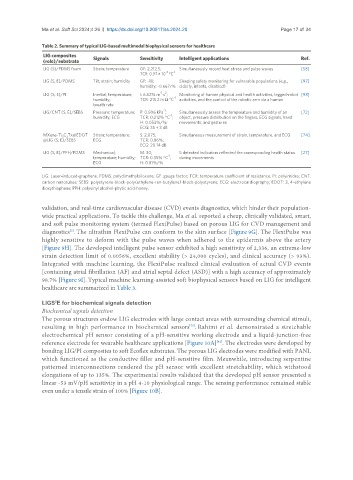
               Table 2. Summary of typical LIG-based multimodal biophysical sensors for healthcare
                LIG composites   Signals        Sensitivity  Intelligent applications                  Ref.
                (role)/substrate
                LIG (S)/PDMS foam  Strain; temperature  GF: 2,212.5;  Simultaneously record heat stress and pulse waves  [58]
                                                         -2
                                                TCR: 0.97 × 10  °C -1
                LIG (S, E)/PDMS  Tilt; strain; humidity  GF: ~10;   Sleeping safety monitoring for vulnerable populations (e.g.,   [97]
                                                humidity: -0.667/% elderly, infants, disabled)
                                                       -1 2
                LIG (S, E)/PI   Inertial; temperature;   I: 6.52% m ·s ;   Monitoring of human physical and health activities, legged-robot  [98]
                                humidity;       TCR: 215.2 m·Ω·°C -1  activities, and the control of the robotic arm via a human
                                breath rate
                                                        -1
                LIG/CNT (S, E)/SEBS  Pressure; temperature;  P: 0.506 kPa ;   Simultaneously assess the temperature and humidity of an   [72]
                                                          -1
                                humidity; ECG   TCR: 0.212% °C ;   object, pressure distribution on the fingers, ECG signals, hand
                                                H: 0.053%/%;   movements, and gestures
                                                ECG: 35 ± 3 dB
                MXene-Ti C Tx@EDOT   Strain; temperature;   S: 2,075;   Simultaneous measurement of strain, temperature, and ECG  [74]
                      3 2
                @LIG (S, E)/SEBS  ECG           TCR: 0.86%;
                                                ECG: 20.14 dB
                LIG (S, E)/PPH/PDMS  Mechanical;   M: 30;    5 detected indicators reflected the corresponding health status   [27]
                                                          -1
                                temperature; humidity;   TCR: 0.35% °C ;   during movements
                                ECG             H: 0.81%/%
               LIG: Laser-induced-graphene; PDMS: polydimethylsiloxane; GF: gauge factor; TCR: temperature coefficient of resistance; PI: polyimides; CNT:
               carbon nanotubes; SEBS: polystyrene-block-poly(ethylene-ran-butylene)-block-polystyrene; ECG: electrocardiography; EDOT: 3, 4-ethylene
               dioxythiophene; PPH: polyvinyl alcohol-phytic acid-honey.


               validation, and real-time cardiovascular disease (CVD) events diagnostics, which hinder their population-
               wide practical applications. To tackle this challenge, Ma et al. reported a cheap, clinically validated, smart,
               and soft pulse monitoring system (termed FlexiPulse) based on porous LIG for CVD management and
                         [3]
               diagnostics . The ultrathin FlexiPulse can conform to the skin surface [Figure 9G]. The FlexiPulse was
               highly sensitive to deform with the pulse waves when adhered to the epidermis above the artery
               [Figure 9H]. The developed intelligent pulse sensor exhibited a high sensitivity of 2,336, an extreme-low
               strain detection limit of 0.0056%, excellent stability (> 24,000 cycles), and clinical accuracy (> 93%).
               Integrated with machine learning, the FlexiPulse realized clinical evaluation of actual CVD events
               [containing atrial fibrillation (AF) and atrial septal defect (ASD)] with a high accuracy of approximately
               98.7% [Figure 9I]. Typical machine learning-assisted soft biophysical sensors based on LIG for intelligent
               healthcare are summarized in Table 3.

                    2
               LIGS E for biochemical signals detection
               Biochemical signals detection
               The porous structures endow LIG electrodes with large contact areas with surrounding chemical stimuli,
                                                                 [75]
               resulting in high performance in biochemical sensors . Rahimi et al. demonstrated a stretchable
               electrochemical pH sensor consisting of a pH-sensitive working electrode and a liquid-junction-free
                                                                          [41]
               reference electrode for wearable healthcare applications [Figure 10A] . The electrodes were developed by
               bonding LIG/PI composites to soft Ecoflex substrates. The porous LIG electrodes were modified with PANI,
               which functioned as the conductive filler and pH-sensitive film. Meanwhile, introducing serpentine
               patterned interconnections rendered the pH sensor with excellent stretchability, which withstood
               elongations of up to 135%. The experimental results validated that the developed pH sensor presented a
               linear -53 mV/pH sensitivity in a pH 4-10 physiological range. The sensing performance remained stable
               even under a tensile strain of 100% [Figure 10B].

