


Page 50 - Read Online
P. 50
Page 22 of 38                            Wei et al. Soft Sci 2023;3:17  https://dx.doi.org/10.20517/ss.2023.09


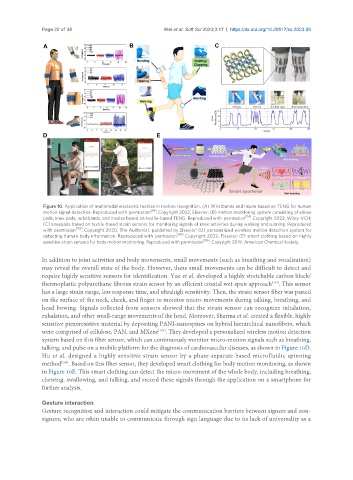
                Figure 10. Application of multimodal electronic textiles in motion recognition. (A) Wristbands and insole based on TENG for human
                motion signal detection. Reproduced with  permission [94] . Copyright 2022, Elsevier; (B) motion monitoring system consisting of elbow
                pads, knee pads, wristbands, and insoles based on textile-based TENG. Reproduced with  permission [54] . Copyright 2022, Wiley-VCH;
                (C) kneepads based on textile-based strain sensors for monitoring signals of knee activities during walking and running. Reproduced
                with  permission [182] . Copyright 2020, The Author(s), published by Elsevier; (D) personalized wireless motion detection system for
                detecting human body information. Reproduced with  permission [185] . Copyright 2022, Elsevier; (E) smart clothing based on highly
                sensitive strain sensors for body motion monitoring. Reproduced with permission [186] . Copyright 2019, American Chemical Society.


               In addition to joint activities and body movements, small movements (such as breathing and vocalization)
               may reveal the overall state of the body. However, these small movements can be difficult to detect and
               require highly sensitive sensors for identification. Yue et al. developed a highly stretchable carbon black/
               thermoplastic polyurethane fibrous strain sensor by an efficient coaxial wet-spun approach . This sensor
                                                                                             [184]
               has a large strain range, less response time, and ultrahigh sensitivity. Then, the strain sensor fiber was pasted
               on the surface of the neck, cheek, and finger to monitor micro-movements during talking, breathing, and
               head bowing. Signals collected from sensors showed that the strain sensor can recognize inhalation,
               exhalation, and other small-range movements of the head. Moreover, Sharma et al. created a flexible, highly
               sensitive piezoresistive material by depositing PANI-nanospines on hybrid hierarchical nanofibers, which
               were comprised of cellulose, PAN, and MXene . They developed a personalized wireless motion detection
                                                      [185]
               system based on this fiber sensor, which can continuously monitor micro-motion signals such as breathing,
               talking, and pulse on a mobile platform for the diagnosis of cardiovascular diseases, as shown in Figure 10D.
               Hu et al. designed a highly sensitive strain sensor by a phase-separate-based microfluidic spinning
                      [186]
               method . Based on this fiber sensor, they developed smart clothing for body motion monitoring, as shown
               in Figure 10E. This smart clothing can detect the micro-movement of the whole body, including breathing,
               chewing, swallowing, and talking, and record these signals through the application on a smartphone for
               further analysis.

               Gesture interaction
               Gesture recognition and interaction could mitigate the communication barriers between signers and non-
               signers, who are often unable to communicate through sign language due to its lack of universality as a

