


Page 48 - Read Online
P. 48
Page 20 of 38                            Wei et al. Soft Sci 2023;3:17  https://dx.doi.org/10.20517/ss.2023.09


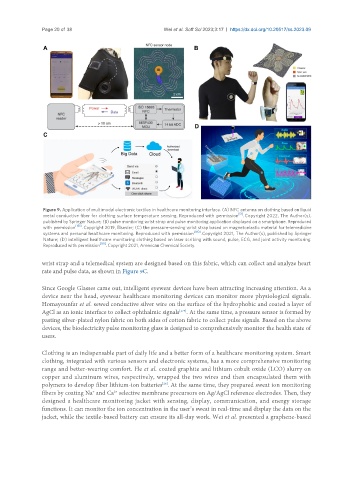
                Figure 9. Application of multimodal electronic textiles in healthcare monitoring interface. (A) NFC antenna on clothing based on liquid
                metal conductive fiber for clothing surface temperature sensing. Reproduced with  permission [51] . Copyright 2022, The Author(s),
                published by Springer Nature; (B) pulse monitoring wrist strap and pulse monitoring application displayed on a smartphone. Reproduced
                with permission [155] . Copyright 2019, Elsevier; (C) the pressure-sensing wrist strap based on magnetoelastic material for telemedicine
                systems and personal healthcare monitoring. Reproduced with  permission [180] . Copyright 2021, The Author(s), published by Springer
                Nature; (D) intelligent healthcare monitoring clothing based on laser scribing with sound, pulse, ECG, and joint activity monitoring.
                Reproduced with permission [181] . Copyright 2021, American Chemical Society.


               wrist strap and a telemedical system are designed based on this fabric, which can collect and analyze heart
               rate and pulse data, as shown in Figure 9C.


               Since Google Glasses came out, intelligent eyewear devices have been attracting increasing attention. As a
               device near the head, eyewear healthcare monitoring devices can monitor more physiological signals.
               Homayounfar et al. sewed conductive silver wire on the surface of the hydrophobic and coated a layer of
                                                             [179]
               AgCl as an ionic interface to collect ophthalmic signals . At the same time, a pressure sensor is formed by
               pasting silver-plated nylon fabric on both sides of cotton fabric to collect pulse signals. Based on the above
               devices, the bioelectricity pulse monitoring glass is designed to comprehensively monitor the health state of
               users.


               Clothing is an indispensable part of daily life and a better form of a healthcare monitoring system. Smart
               clothing, integrated with various sensors and electronic systems, has a more comprehensive monitoring
               range and better-wearing comfort. He et al. coated graphite and lithium cobalt oxide (LCO) slurry on
               copper and aluminum wires, respectively, wrapped the two wires and then encapsulated them with
               polymers to develop fiber lithium-ion batteries . At the same time, they prepared sweat ion monitoring
                                                        [26]
                                +
                                       2+
               fibers by coating Na  and Ca  selective membrane precursors on Ag/AgCl reference electrodes. Then, they
               designed a healthcare monitoring jacket with sensing, display, communication, and energy storage
               functions. It can monitor the ion concentration in the user’s sweat in real-time and display the data on the
               jacket, while the textile-based battery can ensure its all-day work. Wei et al. presented a graphene-based

