


Page 43 - Read Online
P. 43
Wei et al. Soft Sci 2023;3:17  https://dx.doi.org/10.20517/ss.2023.09           Page 15 of 38


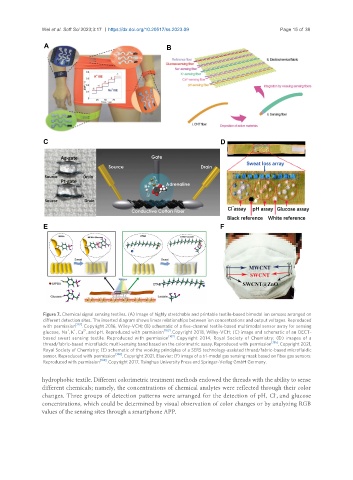
                Figure 7. Chemical signal sensing textiles. (A) Image of highly stretchable and printable textile-based bimodal ion sensors arranged on
                different detection sites. The inserted diagram shows linear relationships between ion concentrations and output voltages. Reproduced
                with  permission [162] . Copyright 2016, Wiley-VCH; (B) schematic of a five-channel textile-based multimodal sensor array for sensing
                          +
                             2+
                        +
                glucose,  Na , K , Ca , and pH. Reproduced with  permission [163] . Copyright 2018, Wiley-VCH; (C) image and schematic of an OECT-
                based  sweat  sensing  textile.  Reproduced  with  permission [167] . Copyright  2014,  Royal  Society  of  Chemistry;  (D)  images  of  a
                thread/fabric-based microfluidic multi-sensing band based on the colorimetric assay. Reproduced with permission [165] . Copyright 2021,
                Royal Society of Chemistry; (E) schematic of the working principles of a SERS technology-assisted thread/fabric-based microfluidic
                sensor. Reproduced with permission [166] . Copyright 2021, Elsevier; (F) image of a tri-modal gas sensing mask based on fiber gas sensors.
                Reproduced with permission [168] . Copyright 2017, Tsinghua University Press and Springer-Verlag GmbH Germany.
               hydrophobic textile. Different colorimetric treatment methods endowed the threads with the ability to sense
               different chemicals; namely, the concentrations of chemical analytes were reflected through their color
               changes. Three groups of detection patterns were arranged for the detection of pH, Cl , and glucose
                                                                                              -
               concentrations, which could be determined by visual observation of color changes or by analyzing RGB
               values of the sensing sites through a smartphone APP.

