


Page 41 - Read Online
P. 41
Wei et al. Soft Sci 2023;3:17  https://dx.doi.org/10.20517/ss.2023.09           Page 13 of 38


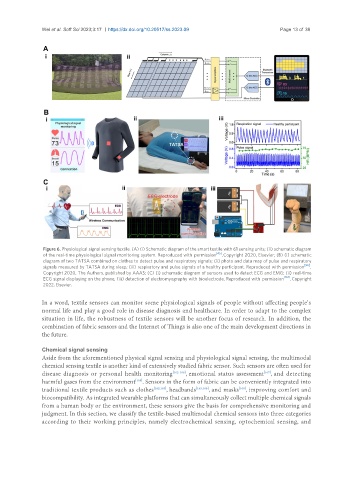
                Figure 6. Physiological signal sensing textile. (A) (i) Schematic diagram of the smart textile with 61 sensing units; (ii) schematic diagram
                of the real-time physiological signal monitoring system. Reproduced with  permission [45] . Copyright 2020, Elsevier; (B) (i) schematic
                diagram of two TATSA combined on clothes to detect pulse and respiratory signals; (ii) photo and data map of pulse and respiratory
                signals measured by TATSA during sleep; (iii) respiratory and pulse signals of a healthy participant. Reproduced with  permission [96] .
                Copyright 2020, The Authors, published by AAAS; (C) (i) schematic diagram of sensors used to detect ECG and EMG; (ii) real-time
                ECG signal displaying on the phone; (iii) detection of electromyography with bioelectrode. Reproduced with  permission [161] . Copyright
                2022, Elsevier.

               In a word, textile sensors can monitor some physiological signals of people without affecting people’s
               normal life and play a good role in disease diagnosis and healthcare. In order to adapt to the complex
               situation in life, the robustness of textile sensors will be another focus of research. In addition, the
               combination of fabric sensors and the Internet of Things is also one of the main development directions in
               the future.

               Chemical signal sensing
               Aside from the aforementioned physical signal sensing and physiological signal sensing, the multimodal
               chemical sensing textile is another kind of extensively studied fabric sensor. Such sensors are often used for
               disease diagnosis or personal health monitoring [162-166] , emotional status assessment , and detecting
                                                                                          [167]
               harmful gases from the environment . Sensors in the form of fabric can be conveniently integrated into
                                               [168]
               traditional textile products such as clothes [162,163] , headbands [165,166] , and masks , improving comfort and
                                                                                  [168]
               biocompatibility. As integrated wearable platforms that can simultaneously collect multiple chemical signals
               from a human body or the environment, these sensors give the basis for comprehensive monitoring and
               judgment. In this section, we classify the textile-based multimodal chemical sensors into three categories
               according to their working principles, namely electrochemical sensing, optochemical sensing, and

