


Page 39 - Read Online
P. 39
Wei et al. Soft Sci 2023;3:17  https://dx.doi.org/10.20517/ss.2023.09           Page 11 of 38


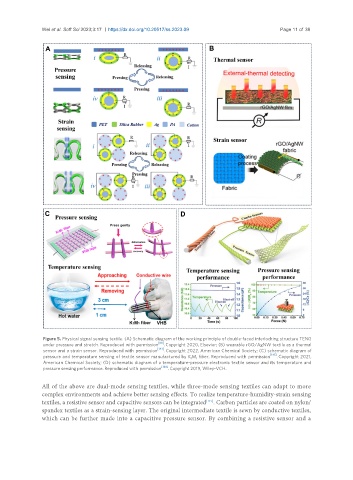
                Figure 5. Physical signal sensing textile. (A) Schematic diagram of the working principle of double-faced interlocking structure TENG
                under pressure and stretch. Reproduced with  permission [68] . Copyright 2020, Elsevier; (B) wearable rGO/AgNW textile as a thermal
                sensor and a strain sensor. Reproduced with  permission [143] . Copyright 2022, American Chemical Society; (C) schematic diagram of
                pressure and temperature sensing of textile sensor manufactured by K M  fiber. Reproduced with  permission [145] . Copyright 2021,
                                                                   1
                                                                 1
                American Chemical Society; (D) schematic diagram of a temperature-pressure electronic textile sensor and its temperature and
                pressure sensing performance. Reproduced with permission [146] . Copyright 2019, Wiley-VCH.
               All of the above are dual-mode sensing textiles, while three-mode sensing textiles can adapt to more
               complex environments and achieve better sensing effects. To realize temperature-humidity-strain sensing
                                                                       [147]
               textiles, a resistive sensor and capacitive sensors can be integrated . Carbon particles are coated on nylon/
               spandex textiles as a strain-sensing layer. The original intermediate textile is sewn by conductive textiles,
               which can be further made into a capacitive pressure sensor. By combining a resistive sensor and a

