


Page 45 - Read Online
P. 45
Wei et al. Soft Sci 2023;3:17  https://dx.doi.org/10.20517/ss.2023.09           Page 17 of 38


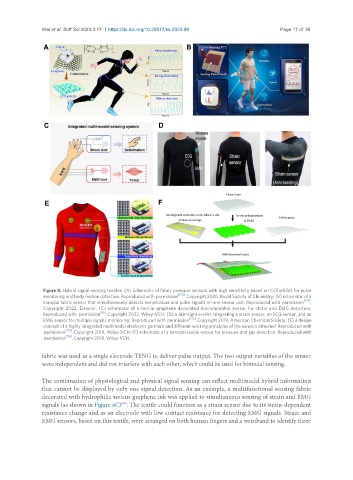
                Figure 8. Hybrid signal sensing textiles. (A) Schematic of fabric pressure sensors with high sensitivity based on CCF@RGO for pulse
                monitoring and body motion detection. Reproduced with permission [170] . Copyright 2020, Royal Society of Chemistry; (B) schematic of a
                bimodal fabric sensor that simultaneously detects temperature and pulse signals on one sensor unit. Reproduced with  permission [171] .
                Copyright 2022, Elsevier; (C) schematic of a sericin-graphene decorated biocompatible sensor for strain and EMG detection.
                Reproduced with permission [55] . Copyright 2022, Wiley-VCH; (D) a skin-tight e-shirt integrating a strain sensor, an ECG sensor, and an
                EMG sensor for multiple signals monitoring. Reproduced with permission [172] . Copyright 2019, American Chemical Society; (E) a design
                concept of a highly integrated multimodal electronic garment and different working principles of the sensors attached. Reproduced with
                permission [173] . Copyright 2019, Wiley-VCH; (F) schematic of a bimodal textile sensor for pressure and gas detection. Reproduced with
                permission [176] . Copyright 2018, Wiley-VCH.

               fabric was used as a single electrode TENG to deliver pulse output. The two output variables of the sensor
               were independent and did not interfere with each other, which could be used for bimodal sensing.

               The combination of physiological and physical signal sensing can reflect multimodal hybrid information
               that cannot be displayed by only one signal detection. As an example, a multifunctional sensing fabric
               decorated with hydrophilic sericin-graphene ink was applied to simultaneous sensing of strain and EMG
                                          [55]
               signals (as shown in Figure 8C) . The textile could function as a strain sensor due to its strain-dependent
               resistance change and as an electrode with low contact resistance for detecting EMG signals. Strain and
               EMG sensors, based on this textile, were arranged on both human fingers and a wristband to identify three

