


Page 34 - Read Online
P. 34
Jung et al. Soft Sci 2024;4:15  https://dx.doi.org/10.20517/ss.2024.02          Page 13 of 44

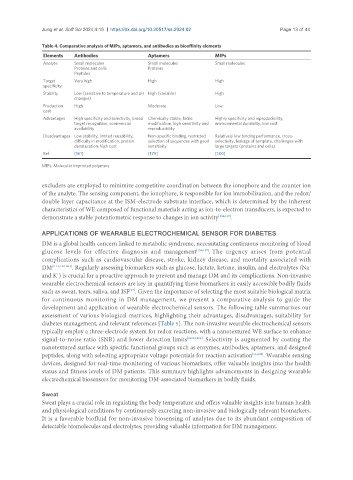
               Table 4. Comparative analysis of MIPs, aptamers, and antibodies as bioaffinity elements
                Elements  Antibodies               Aptamers               MIPs
                Analyte   Small molecules          Small molecules        Small molecules
                          Proteins and cells       Proteins
                          Peptides
                Target    Very high                High                   High
                specificity
                Stability  Low (sensitive to temperature and pH  High (variable)  High
                          changes)
                Production   High                  Moderate               Low
                cost
                Advantages  High specificity and selectivity, broad  Chemically stable, facile   Highly specificity and reproducibility,
                          target recognition, commercial   modification, high sensitivity and   environmental durability, low cost
                          availability             reproducibility
                Disadvantages Low stability, limited reusability,   Non-specific binding, restricted   Relatively low binding performance, cross-
                          difficulty in modification, protein   selection of sequences with good   selectivity, leakage of template, challenges with
                          denaturation, high cost  sensitivity            large targets (proteins and cells)
                Ref.      [161]                    [179]                  [180]
               MIPs: Molecular imprinted polymers.


               excluders are employed to minimize competitive coordination between the ionophore and the counter ion
               of the analyte. The sensing component, the ionophore, is responsible for ion immobilization, and the redox/
               double layer capacitance at the ISM-electrode substrate interface, which is determined by the inherent
               characteristics of WE composed of functional materials acting as ion-to-electron transducers, is expected to
               demonstrate a stable potentiometric response to changes in ion activity [194,195] .


               APPLICATIONS OF WEARABLE ELECTROCHEMICAL SENSOR FOR DIABETES
               DM is a global health concern linked to metabolic syndrome, necessitating continuous monitoring of blood
               glucose  levels  for  effective  diagnosis  and  management [196,197] . The  urgency  arises  from  potential
               complications such as cardiovascular disease, stroke, kidney disease, and mortality associated with
                                                                                                         +
               DM  [9-14,198-201] . Regularly assessing biomarkers such as glucose, lactate, ketone, insulin, and electrolytes (Na
               and K ) is crucial for a proactive approach to prevent and manage DM and its complications. Non-invasive
                    +
               wearable electrochemical sensors are key in quantifying these biomarkers in easily accessible bodily fluids
                                             [97]
               such as sweat, tears, saliva, and ISF . Given the importance of selecting the most suitable biological matrix
               for continuous monitoring in DM management, we present a comparative analysis to guide the
               development and application of wearable electrochemical sensors. The following table summarizes our
               assessment of various biological matrices, highlighting their advantages, disadvantages, suitability for
               diabetes management, and relevant references [Table 5]. The non-invasive wearable electrochemical sensors
               typically employ a three-electrode system for redox reactions, with a nanotextured WE surface to enhance
               signal-to-noise ratio (SNR) and lower detection limits [89-91,208] . Selectivity is augmented by coating the
               nanotextured surface with specific functional groups such as enzymes, antibodies, aptamers, and designed
               peptides, along with selecting appropriate voltage potentials for reaction activation [51,209] . Wearable sensing
               devices, designed for real-time monitoring of various biomarkers, offer valuable insights into the health
               status and fitness levels of DM patients. This summary highlights advancements in designing wearable
               electrochemical biosensors for monitoring DM-associated biomarkers in bodily fluids.

               Sweat
               Sweat plays a crucial role in regulating the body temperature and offers valuable insights into human health
               and physiological conditions by continuously excreting non-invasive and biologically relevant biomarkers.
               It is a favorable biofluid for non-invasive biosensing of analytes due to its abundant composition of
               detectable biomolecules and electrolytes, providing valuable information for DM management.

