


Page 33 - Read Online
P. 33
Page 12 of 44                            Jung et al. Soft Sci 2024;4:15  https://dx.doi.org/10.20517/ss.2024.02

               Antibodies, Aptamers, and MIPs as bioaffinity elements, along with their target specificity, stability, and
               cost-effectiveness in various sensing applications, are comparatively analyzed in Table 4. This detailed
               comparison aims to equip researchers with a clearer insight into selecting the most suitable bioaffinity
               element for their specific sensor applications.


               Ion-selective membrane
               Ion-selective electrodes (ISEs) constitute a well-established potentiometric sensor technology extensively
               applied across environmental, industrial, and clinical domains to analyze crucial electrolytes [181-183] . The
               burgeoning field of wearable sensors is currently centered on using ISEs for real-time, non-invasive
               monitoring of ions in biological fluids, showing recent advancements geared toward evaluating personal
               physiological states. Potentiometric sensors, specifically designed for ion sensing, have garnered attention
               owing to their compact size, exceptional selectivity, prompt response, low energy consumption, user-
               friendly operation, and economic viability [184,185] .

               These potentiometric sensors, comprising a WE and RE, are presumed to have their potentiometric
               response modeled under open-circuit state, specifically under the condition of zero current. In ISEs, the
                                                                                           [100]
               analytical insight is derived by translating an ion-exchange event into a voltage signal . The electrode
               design focuses on perturbations in the local equilibrium at the interface between an ISM and the sample
               solution. Variations in the activity of the primary ion induce changes in membrane potential and that
               provided by the RE [185,186]  [Figure 3D].


               The potential response of ISEs can be explained by the phase-boundary potential mode, which is based on
               total equilibrium assumptions [187,188] . It relies on charge separation at the solution-membrane interface,
               influenced by primary ion activity through surface chemisorption and equilibrium partitioning of primary
               ions. The energy required for charge separation stems from the chemical driving force, determined by Gibbs
               free energy. Through the perselectivity and ion selectivity of ISMs, primary ions can move across the
               membrane phase unhindered. Upon reaching a state where chemical driving forces counterbalance the
               opposing electrical Coulombinc driving forces, electrochemical equilibrium is attained, forming an electrical
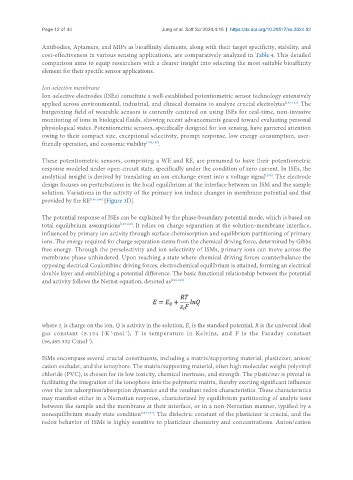
               double layer and establishing a potential difference. The basic functional relationship between the potential
               and activity follows the Nernst equation, denoted as [188-190]


               where z is charge on the ion, Q is activity in the solution, E  is the standard potential, R is the universal ideal
                      i
                                                                 0
                                           -1
                                      -1
               gas  constant  (8.134  J·K ·mol ),  T  is  temperature  in  Kelvins,  and  F  is  the  Faraday  constant
               (96,485.332 C·mol ).
                              -1
               ISMs encompass several crucial constituents, including a matrix/supporting material, plasticizer, anion/
               cation excluder, and the ionophore. The matrix/supporting material, often high molecular weight polyvinyl
               chloride (PVC), is chosen for its low toxicity, chemical inertness, and strength. The plasticizer is pivotal in
               facilitating the integration of the ionophore into the polymeric matrix, thereby exerting significant influence
               over the ion adsorption/absorption dynamics and the resultant redox characteristics. These characteristics
               may manifest either in a Nernstian response, characterized by equilibrium partitioning of analyte ions
               between the sample and the membrane at their interface, or in a non-Nernstian manner, typified by a
               nonequilibrium steady state condition [191-193] . The dielectric constant of the plasticizer is crucial, and the
               redox behavior of ISMs is highly sensitive to plasticizer chemistry and concentrations. Anion/cation

