


Page 35 - Read Online
P. 35
Page 14 of 44                            Jung et al. Soft Sci 2024;4:15  https://dx.doi.org/10.20517/ss.2024.02

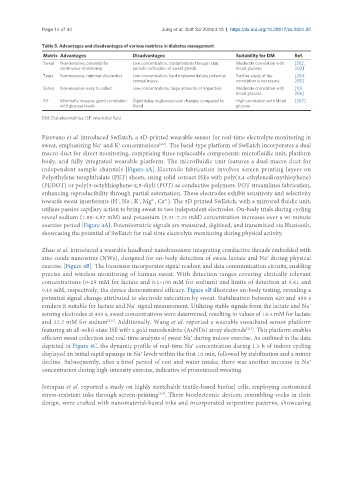
               Table 5. Advantages and disadvantages of various matrices in diabetes management
                Matrix Advantages             Disadvantages                      Suitability for DM  Ref.
                Sweat  Non-invasive, potential for   Low concentration, contaminants through skin,   Moderate correlation with   [202,
                     continuous monitoring    periodic activation of sweat glands  blood glucose    203]
                Tears  Non-invasive, minimal discomfort  Low concentration, hard implementation, potential   Further study of the   [204,
                                              corneal injury                     correlation is necessary  205]
                Saliva  Non-invasive, easy to collect  Low concentrations, large amounts of impurities  Moderate correlation with   [101,
                                                                                 blood glucose      206]
                ISF  Minimally invasive, good correlation   Slight delay in glucose level changes compared to   High correlation with blood   [207]
                     with glucose levels      blood                              glucose
               DM: Diabetes mellitus; ISF: interstitial fluid.


               Pirovano et al. introduced SwEatch, a 3D-printed wearable sensor for real-time electrolyte monitoring in
               sweat, emphasizing Na  and K  concentrations . The band-type platform of SwEatch incorporates a dual
                                                       [210]
                                   +
                                         +
               macro-duct for direct monitoring, comprising three replaceable components: microfluidic unit, platform
               body, and fully integrated wearable platform. The microfluidic unit features a dual macro duct for
               independent sample channels [Figure 4A]. Electrode fabrication involves screen printing layers on
               Polyethylene terephthalate (PET) sheets, using solid contact ISEs with poly(3,4-ethylenedioxythiophene)
               (PEDOT) or poly(3-octylthiophene-2,5-diyl) (POT) as conductive polymers. POT streamlines fabrication,
               enhancing reproducibility through partial automation. These electrodes exhibit sensitivity and selectivity
               towards sweat interferents (H , Na , K , Mg , Ca ). The 3D printed SwEatch, with a mirrored fluidic unit,
                                                        2+
                                                    2+
                                                +
                                         +
                                             +
               utilizes passive capillary action to bring sweat to two independent electrodes. On-body trials during cycling
               reveal sodium (1.89-2.97 mM) and potassium (3.31-7.25 mM) concentration increases over a 90-minute
               exercise period [Figure 4A]. Potentiometric signals are measured, digitized, and transmitted via Bluetooth,
               showcasing the potential of SwEatch for real-time electrolyte monitoring during physical activity.
               Zhao et al. introduced a wearable headband nanobiosensor integrating conductive threads embedded with
               zinc-oxide nanowires (NWs), designed for on-body detection of sweat lactate and Na  during physical
                                                                                           +
               exercise [Figure 4B]. The biosensor incorporates signal readout and data communication circuits, enabling
               precise and wireless monitoring of human sweat. With detection ranges covering clinically relevant
               concentrations (0-25 mM for lactate and 0.1-100 mM for sodium) and limits of detection at 3.61 and
               0.16 mM, respectively, the device demonstrated efficacy. Figure 4B illustrates on-body testing, revealing a
               potential signal change attributed to electrode saturation by sweat. Stabilization between 420 and 450 s
               renders it suitable for lactate and Na  signal measurement. Utilizing stable signals from the lactate and Na
                                                                                                         +
                                              +
               sensing electrodes at 450 s, sweat concentrations were determined, resulting in values of 18.4 mM for lactate
               and 22.7 mM for sodium . Additionally, Wang et al. reported a wearable sweatband sensor platform
                                     [211]
                                                                                    [212]
               featuring an all-solid-state ISE with a gold nanodendrite (AuNDs) array electrode . This platform enables
               efficient sweat collection and real-time analysis of sweat Na  during indoor exercise. As outlined in the data
                                                                 +
               depicted in Figure 4C, the dynamic profile of real-time Na  concentration during 1.5 h of indoor cycling
                                                                  +
                                                +
               displayed an initial rapid upsurge in Na  levels within the first 10 min, followed by stabilization and a minor
                                                                                                         +
               decline. Subsequently, after a brief period of rest and water intake, there was another increase in Na
               concentration during high-intensity exercise, indicative of pronounced sweating.
               Jeerapan et al. reported a study on highly stretchable textile-based biofuel cells, employing customized
                                                      [213]
               stress-resistant inks through screen-printing . These bioelectronic devices, resembling socks in their
               design, were crafted with nanomaterial-based inks and incorporated serpentine patterns, showcasing

