


Page 29 - Read Online
P. 29
Page 8 of 44                             Jung et al. Soft Sci 2024;4:15  https://dx.doi.org/10.20517/ss.2024.02

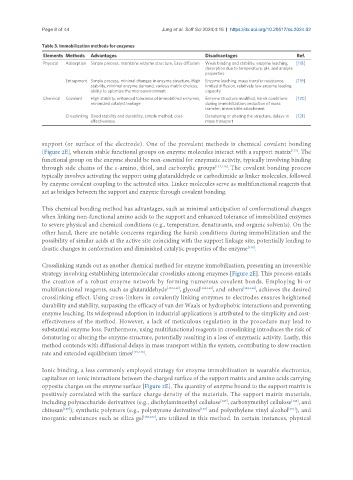
               Table 3. Immobilization methods for enzymes
                Elements Methods  Advantages                          Disadvantages                  Ref.
                Physical  Adsorption Simple process, maintains enzyme structure, Easy diffusion  Weak binding and stability, enzyme leaching,   [118]
                                                                      desorption due to temperature, pH, and analyte
                                                                      properties
                       Entrapment Simple process, minimal changes in enzyme structure, High  Enzyme leaching, mass transfer resistance,   [119]
                                stability, minimal enzyme demand, various matrix choices,   limited diffusion, relatively low enzyme loading
                                ability to optimize the microenvironment  capacity
                Chemical  Covalent  High stability, enhanced tolerance of immobilized enzymes,  Enzyme structure modified, harsh conditions   [120]
                                minimized catalyst leakage            during immobilization, reduction of mass
                                                                      transfer, irreversible attachment
                       Crosslinking Good stability and durability, simple method, cost-  Denaturing or altering the structure, delays in   [121]
                                effectiveness                         mass transport


               support (or surface of the electrode). One of the prevalent methods is chemical covalent bonding
                                                                                                   [137]
               [Figure 2E], wherein stable functional groups on enzyme molecules interact with a support matrix . The
               functional group on the enzyme should be non-essential for enzymatic activity, typically involving binding
               through side chains of the ε-amino, thiol, and carboxylic groups [137,138] . The covalent bonding process
               typically involves activating the support using glutaraldehyde or carbodiimide as linker molecules, followed
               by enzyme covalent coupling to the activated sites. Linker molecules serve as multifunctional reagents that
               act as bridges between the support and enzyme through covalent bonding.

               This chemical bonding method has advantages, such as minimal anticipation of conformational changes
               when linking non-functional amino acids to the support and enhanced tolerance of immobilized enzymes
               to severe physical and chemical conditions (e.g., temperature, denaturants, and organic solvents). On the
               other hand, there are notable concerns regarding the harsh conditions during immobilization and the
               possibility of similar acids at the active site coinciding with the support linkage site, potentially leading to
                                                                                     [138]
               drastic changes in conformation and diminished catalytic properties of the enzyme .
               Crosslinking stands out as another chemical method for enzyme immobilization, presenting an irreversible
               strategy involving establishing intermolecular crosslinks among enzymes [Figure 2E]. This process entails
               the creation of a robust enzyme network by forming numerous covalent bonds. Employing bi-or
               multifunctional reagents, such as glutaraldehyde [139,140] , glyoxal [141,142] , and others [143,144] , achieves the desired
               crosslinking effect. Using cross-linkers in covalently linking enzymes to electrodes ensures heightened
               durability and stability, surpassing the efficacy of van der Waals or hydrophobic interactions and preventing
               enzyme leaching. Its widespread adoption in industrial applications is attributed to the simplicity and cost-
               effectiveness of the method. However, a lack of meticulous regulation in the procedure may lead to
               substantial enzyme loss. Furthermore, using multifunctional reagents in crosslinking introduces the risk of
               denaturing or altering the enzyme structure, potentially resulting in a loss of enzymatic activity. Lastly, this
               method contends with diffusional delays in mass transport within the system, contributing to slow reaction
               rate and extended equilibrium times [145,146] .

               Ionic binding, a less commonly employed strategy for enzyme immobilization in wearable electronics,
               capitalizes on ionic interactions between the charged surface of the support matrix and amino acids carrying
               opposite charges on the enzyme surface [Figure 2E]. The quantity of enzyme bound to the support matrix is
               positively correlated with the surface charge density of the materials. The support matrix materials,
               including polysaccharide derivatives (e.g., diethylaminoethyl cellulose , carboxymethyl cellulose , and
                                                                           [147]
                                                                                                   [148]
                      [149]
                                                                    [150]
                                                                                                  [151]
               chitosan ), synthetic polymers (e.g., polystyrene derivatives  and polyethylene vinyl alcohol ), and
               inorganic substances such as silica gel [152,153] , are utilized in this method. In certain instances, physical

