


Page 27 - Read Online
P. 27
Page 6 of 44                             Jung et al. Soft Sci 2024;4:15  https://dx.doi.org/10.20517/ss.2024.02


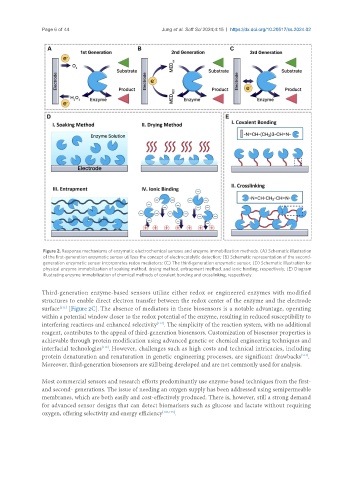
                Figure 2. Response mechanisms of enzymatic electrochemical sensors and enzyme immobilization methods. (A) Schematic illustration
                of the first-generation enzymatic sensor utilizes the concept of electrocatalytic detection; (B) Schematic representation of the second-
                generation enzymatic sensor incorporates redox mediators; (C) The third-generation enzymatic sensor; (D) Schematic illustration for
                physical enzyme immobilization of soaking method, drying method, entrapment method, and ionic binding, respectively; (E) Diagram
                illustrating enzyme immobilization of chemical methods of covalent bonding and crosslinking, respectively.


               Third-generation enzyme-based sensors utilize either redox or engineered enzymes with modified
               structures to enable direct electron transfer between the redox center of the enzyme and the electrode
               surface  [Figure 2C]. The absence of mediators in these biosensors is a notable advantage, operating
                     [111]
               within a potential window closer to the redox potential of the enzyme, resulting in reduced susceptibility to
               interfering reactions and enhanced selectivity . The simplicity of the reaction system, with no additional
                                                      [112]
               reagent, contributes to the appeal of third-generation biosensors. Customization of biosensor properties is
               achievable through protein modification using advanced genetic or chemical engineering techniques and
               interfacial technologies . However, challenges such as high costs and technical intricacies, including
                                   [113]
               protein denaturation and renaturation in genetic engineering processes, are significant drawbacks .
                                                                                                       [114]
               Moreover, third-generation biosensors are still being developed and are not commonly used for analysis.

               Most commercial sensors and research efforts predominantly use enzyme-based techniques from the first-
               and second- generations. The issue of needing an oxygen supply has been addressed using semipermeable
               membranes, which are both easily and cost-effectively produced. There is, however, still a strong demand
               for advanced sensor designs that can detect biomarkers such as glucose and lactate without requiring
               oxygen, offering selectivity and energy efficiency [101,115] .

