


Page 24 - Read Online
P. 24
Jung et al. Soft Sci 2024;4:15  https://dx.doi.org/10.20517/ss.2024.02           Page 3 of 44

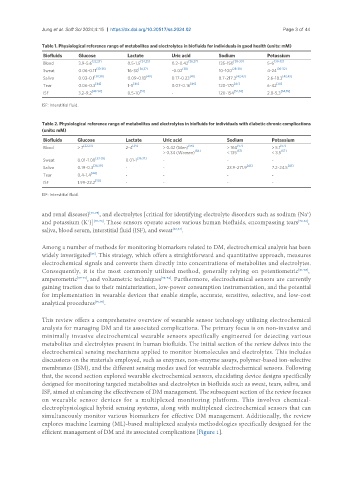
               Table 1. Physiological reference range of metabolites and electrolytes in biofluids for individuals in good health (units: mM)
                Biofluids  Glucose          Lactate        Uric acid       Sodium          Potassium
                Blood      3.9~5.6 [22,23]  0.5~1.5 [24,25]  0.2~0.42 [26,27]  135~150 [28-30]  5~6 [30-32]
                                 [33-35]        [36,37]        [38]            [28-30]        [30-32]
                Sweat      0.06~0.11        16~30          ~0.02           10~100          4~24
                                 [38,39]          [40]           [41]            [42,43]        [42,43]
                Saliva     0.03~0.1         0.09~0.13      0.17~0.23       8.7~217.3       2.6~18.3
                                 [44]         [45]               [46]           [47]          [47]
                Tear       0.06~0.3         1~5            0.07~0.16       120~170         6~42
                                [48-50]         [51]                            [52,53]         [54,55]
                ISF        3.2~9.2          0.5~10         -               120~154         2.8~5.3
               ISF: Interstitial fluid.

               Table 2. Physiological reference range of metabolites and electrolytes in biofluids for individuals with diabetic chronic complications
               (units: mM)
                Biofluids  Glucose         Lactate      Uric acid             Sodium         Potassium
                Blood      > 7 [22,23]     2~4 [25]     > 0.42 (Men) [56]     > 160 [57]     > 5.1 [57]
                                                                   [56]          [57]           [57]
                                                        > 0.34 (Women)        < 135          < 3.5
                                 [33-35]       [36,37]
                Sweat      0.01~1.00       0.01~1       -                     -              -
                                [38,39]                                             [43]          [43]
                Saliva     0.19~0.3        -            -                     23.9~271.9     7.2~24.5
                                [44]
                Tear       0.4~1.4         -            -                     -              -
                ISF        1.99~22.2 [50]  -            -                     -              -
               ISF: Interstitial fluid.

               and renal diseases) [73-75] , and electrolytes [critical for identifying electrolyte disorders such as sodium (Na )
                                                                                                         +
               and potassium (K )] [76-78] . These sensors operate across various human biofluids, encompassing tears [79-82] ,
                               +
               saliva, blood serum, interstitial fluid (ISF), and sweat [83,84] .

               Among a number of methods for monitoring biomarkers related to DM, electrochemical analysis has been
                               [85]
               widely investigated . This strategy, which offers a straightforward and quantitative approach, measures
               electrochemical signals and converts them directly into concentrations of metabolites and electrolytes.
               Consequently, it is the most commonly utilized method, generally relying on potentiometric [86-88] ,
               amperometric [89-91] , and voltametric techniques [92-94] . Furthermore, electrochemical sensors are currently
               gaining traction due to their miniaturization, low-power consumption instrumentation, and the potential
               for implementation in wearable devices that enable simple, accurate, sensitive, selective, and low-cost
               analytical procedures [95,96] .

               This review offers a comprehensive overview of wearable sensor technology utilizing electrochemical
               analysis for managing DM and its associated complications. The primary focus is on non-invasive and
               minimally invasive electrochemical wearable sensors specifically engineered for detecting various
               metabolites and electrolytes present in human biofluids. The initial section of the review delves into the
               electrochemical sensing mechanisms applied to monitor biomolecules and electrolytes. This includes
               discussions on the materials employed, such as enzymes, non-enzyme assays, polymer-based ion-selective
               membranes (ISM), and the different sensing modes used for wearable electrochemical sensors. Following
               that, the second section explored wearable electrochemical sensors, elucidating device designs specifically
               designed for monitoring targeted metabolites and electrolytes in biofluids such as sweat, tears, saliva, and
               ISF, aimed at enhancing the effectiveness of DM management. The subsequent section of the review focuses
               on  wearable  sensor  devices  for  a  multiplexed  monitoring  platform.  This  involves  chemical-
               electrophysiological hybrid sensing systems, along with multiplexed electrochemical sensors that can
               simultaneously monitor various biomarkers for effective DM management. Additionally, the review
               explores machine learning (ML)-based multiplexed analysis methodologies specifically designed for the
               efficient management of DM and its associated complications [Figure 1].

