


Page 66 - Read Online
P. 66
Lin et al. Soft Sci 2023;3:14  https://dx.doi.org/10.20517/ss.2023.05            Page 3 of 25

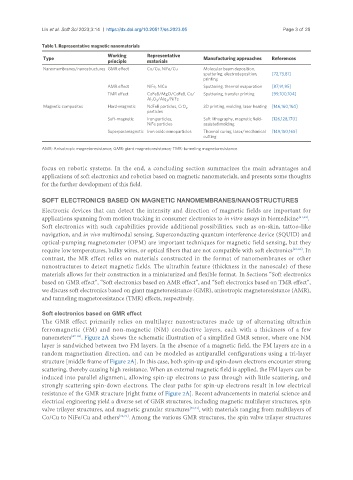
               Table 1. Representative magnetic nanomaterials
                                     Working       Representative
                Type                                                  Manufacturing approaches  References
                                     principle     materials
                Nanomembranes/nanostructures  GMR effect  Co/Cu, NiFe/Cu  Molecular beam deposition,
                                                                      sputtering, electrodeposition,   [72,73,81]
                                                                      printing
                                     AMR effect    NiFe, NiCo         Sputtering, thermal evaporation   [87,91,95]
                                     TMR effect    CoFeB/MgO/CoFeB, Co/  Sputtering, transfer printing  [99,100,104]
                                                   Al O /Alq /NiFe
                                                    2
                                                         3
                                                      3
                Magnetic composites  Hard-magnetic  NdFeB particles, CrO   2  3D printing, molding, laser heating  [146,160,164]
                                                   particles
                                     Soft-magnetic  Iron particles,   Soft lithography, magnetic field-  [126,128,170]
                                                   NiFe particles     assisted molding
                                     Superparamagnetic Iron oxide nanoparticles  Thermal curing, laser/mechanical   [149,150,165]
                                                                      cutting
               AMR: Anisotropic magnetoresistance; GMR: giant magnetoresistance; TMR: tunneling magnetoresistance.


               focus on robotic systems. In the end, a concluding section summarizes the main advantages and
               applications of soft electronics and robotics based on magnetic nanomaterials, and presents some thoughts
               for the further development of this field.


               SOFT ELECTRONICS BASED ON MAGNETIC NANOMEMBRANES/NANOSTRUCTURES
               Electronic devices that can detect the intensity and direction of magnetic fields are important for
               applications spanning from motion tracking in consumer electronics to in vitro assays in biomedicine [61,62] .
               Soft electronics with such capabilities provide additional possibilities, such as on-skin, tattoo-like
               navigation, and in vivo multimodal sensing. Superconducting quantum interference device (SQUID) and
               optical-pumping magnetometer (OPM) are important techniques for magnetic field sensing, but they
               require low temperatures, bulky wires, or optical fibers that are not compatible with soft electronics [63-66] . In
               contrast, the MR effect relies on materials constructed in the format of nanomembranes or other
               nanostructures to detect magnetic fields. The ultrathin feature (thickness in the nanoscale) of these
               materials allows for their construction in a miniaturized and flexible format. In Sections “Soft electronics
               based on GMR effect”, “Soft electronics based on AMR effect”, and “Soft electronics based on TMR effect”,
               we discuss soft electronics based on giant magnetoresistance (GMR), anisotropic magnetoresistance (AMR),
               and tunneling magnetoresistance (TMR) effects, respectively.


               Soft electronics based on GMR effect
               The GMR effect primarily relies on multilayer nanostructures made up of alternating ultrathin
               ferromagnetic (FM) and non-magnetic (NM) conductive layers, each with a thickness of a few
               nanometers [67-69] . Figure 2A shows the schematic illustration of a simplified GMR sensor, where one NM
               layer is sandwiched between two FM layers. In the absence of a magnetic field, the FM layers are in a
               random magnetization direction, and can be modeled as antiparallel configurations using a tri-layer
               structure [middle frame of Figure 2A]. In this case, both spin-up and spin-down electrons encounter strong
               scattering, thereby causing high resistance. When an external magnetic field is applied, the FM layers can be
               induced into parallel alignment, allowing spin-up electrons to pass through with little scattering, and
               strongly scattering spin-down electrons. The clear paths for spin-up electrons result in low electrical
               resistance of the GMR structure [right frame of Figure 2A]. Recent advancements in material science and
               electrical engineering yield a diverse set of GMR structures, including magnetic multilayer structures, spin
               valve trilayer structures, and magnetic granular structures [70,71] , with materials ranging from multilayers of
               Co/Cu to NiFe/Cu and others [72,73] . Among the various GMR structures, the spin valve trilayer structures

