


Page 67 - Read Online
P. 67
Page 4 of 25                              Lin et al. Soft Sci 2023;3:14  https://dx.doi.org/10.20517/ss.2023.05


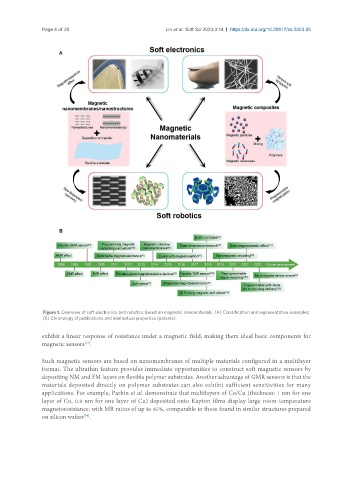
                Figure 1. Overview of soft electronics and robotics based on magnetic nanomaterials. (A) Classification and representative examples;
                (B) Chronology of publications and intellectual properties (patents).

               exhibit a linear response of resistance under a magnetic field, making them ideal basic components for
               magnetic sensors .
                              [73]
               Such magnetic sensors are based on nanomembranes of multiple materials configured in a multilayer
               format. The ultrathin feature provides immediate opportunities to construct soft magnetic sensors by
               depositing NM and FM layers on flexible polymer substrates. Another advantage of GMR sensors is that the
               materials deposited directly on polymer substrates can also exhibit sufficient sensitivities for many
               applications. For example, Parkin et al. demonstrate that multilayers of Co/Cu (thickness: 1 nm for one
               layer of Co, 0.9 nm for one layer of Cu) deposited onto Kapton films display large room-temperature
               magnetoresistance, with MR ratios of up to 65%, comparable to those found in similar structures prepared
               on silicon wafers .
                             [74]

